
If you really enjoy learning from experts and you think you will watch more than one or two courses in a year then MasterClass is a good choice for you. But if you need a certificate when you finish a course or you want a plan to follow or you want people to give you feedback on the projects you do then MasterClass is not the best choice.
The cost of MasterClass starts at $120 per year which’s about $10 per month and you pay for the whole year at once. One of the things about MasterClass is how well the courses are made. They feel like TV shows or documentaries, not just someone talking in front of a camera.. One of the bad things about MasterClass is that it is not very practical. A lot of the courses will inspire you but they will not actually teach you how to do things.
I used MasterClass for weeks, on my computer, phone and TV and I took courses in five different areas. Now I will tell you how I tested MasterClass, what I thought of it and who should use it and who should not use it.
MasterClass Review at a Glance
| Category | Rating |
| Course quality | ⭐⭐⭐⭐⭐ |
| Instructor quality | ⭐⭐⭐⭐⭐ |
| Production quality | ⭐⭐⭐⭐⭐ |
| Practicality | ⭐⭐⭐⭐ |
| Course variety | ⭐⭐⭐⭐⭐ |
| App experience | ⭐⭐⭐⭐⭐ |
| Value for money | ⭐⭐⭐⭐ |
| Career value | ⭐⭐⭐ |
| Overall | ⭐⭐⭐⭐ |
These scores come from the hands-on testing described later in this review, not a general impression of the brand.
Is MasterClass Worth It?
MasterClass is worth it if…
- You enjoy learning from famous practitioners in their field
- You want inspiration and a creative spark, not just a checklist
- You plan to watch multiple courses across different topics
- You prefer video-based learning over reading or live classes
- You’re drawn to creative or lifestyle subjects — cooking, writing, photography, music
MasterClass may not be worth it if…
- You need a professional certification for your résumé
- You want university-level credentials or accreditation
- You’re after highly technical, skills-based training (coding, data analysis, trades)
- You need project-based learning with instructor feedback
- You only plan to watch one or two courses and then cancel
My verdict
If you’re a curious, self-directed learner who wants to binge-watch a rotating library of experts, MasterClass earns its price tag. If you’re job-hunting and need proof of a new skill, put your money toward a platform built around certification instead — I’ll cover a few of those later in this review.
What Is MasterClass?
MasterClass is a subscription based video learning website. It lets famous experts and celebrities teach classes about what they’re best at. Imagine Gordon Ramsay teaching about cooking or Margaret Atwood teaching, about writing or Steph Curry teaching about how to shoot a basketball. The website started in 2015. It now has more than 200 classes. These classes cover food, business, writing, music, sports, science and many other topics.
How MasterClass works
You subscribe annually, then get unlimited streaming access to the entire catalog; there’s no à la carte purchasing and no per-course fee. Courses are broken into short video lessons, usually 10 to 20 minutes each, supported by a downloadable workbook called a Class Guide.
Who teaches MasterClass courses?
Instructors are typically leaders or celebrities in their field rather than professional educators. That’s part of the appeal you’re hearing Ron Finley talk about urban gardening or Bob Iger talk about business strategy, not a generic instructor reading from a script.
What subjects does MasterClass cover?
The catalog spans categories including food and drink, writing, business and leadership, music, film and TV, sports, science and technology, home and lifestyle, and community and wellness. New classes are added regularly, so the library keeps expanding.
How long are MasterClass courses?
Most courses run 3 to 6 hours in total, split across 15 to 30 short lessons. That format is built for watching in small chunks a lesson or two at a time rather than one long sitting.
How MasterClass differs from traditional online courses
Platforms like Coursera or Udemy are built around structured curricula, quizzes, and often certificates. MasterClass is built more like premium streaming content: high production value, narrative pacing, and personality-driven teaching, with fewer formal assessments. It’s closer to a documentary series than a classroom.
My MasterClass Testing Methodology
I want this section to be a genuine differentiator, so here’s exactly how I evaluated the platform rather than just skimming the marketing pages.
How long I tested MasterClass
I used an active subscription over several weeks, watching full courses rather than sampling a few minutes of each one.
Courses and categories tested
I completed courses across business, writing, cooking, and creativity, and sampled lessons in several other categories to check for consistency in production and teaching style.
Devices tested
I streamed on a laptop browser, the iOS mobile app, and a smart TV app to check playback quality, download options, and interface consistency across devices.
Features tested
I tested Class Guides, note-taking, bookmarking, progress tracking, the in-app AI teaching assistant, audio-only playback, offline downloads, subtitle and playback-speed controls, and the overall mobile and TV experience.
How I scored the platform
Each category in the ratings table reflects direct, hands-on use, not the number of stars other sites give it. I weighed teaching clarity, production quality, how usable the supplementary materials were, and whether I came away with something I could actually apply.
MasterClass Course Quality Review
Teaching quality
The teaching quality varies by instructor, but the format is consistent: short lessons, clear structure, and a strong emphasis on storytelling. The best courses feel like a masterclass in the literal sense you’re learning philosophy and mindset as much as technique.
Instructor expertise
There’s no debating expertise here. Instructors are typically top performers in their industries, and their credibility is a major reason people subscribe in the first place.
Course structure
Courses follow a predictable arc: an introduction to the instructor’s philosophy, foundational lessons, more advanced technique, and a closing lesson on mindset or career advice. It’s easy to follow even if you’re new to the subject.
Practical exercises
This is where MasterClass is weaker. Some courses include workbook assignments, but there’s no instructor feedback loop and no grading. You’re largely on your own to apply what you learn.
Class Guides and supplementary materials
Every course comes with a downloadable Class Guide (a PDF workbook) that summarizes key lessons, recipes, or exercises. These are genuinely useful for reference after you finish watching.
Production quality
This is MasterClass’s standout strength. Courses are shot with cinematic lighting, multiple camera angles, and professional editing closer to a Netflix documentary than a typical online course.
Are the courses actually useful?
Yes, with a caveat: they’re most useful for building foundational understanding, mindset, and creative inspiration. They’re less useful if you need step-by-step technical mastery you can immediately apply to a job.
Are some courses better than others?
Definitely. Courses led by instructors who are also natural communicators (chefs, writers, comedians) tend to outperform courses led by brilliant but less expressive experts. Reading a few reviews of a specific course before diving in is worth the extra five minutes.
The Best MasterClass Courses Worth Taking
Best MasterClass courses for business
Instructor: Bob Iger → What you’ll learn: leadership and decision-making at scale → Difficulty: Beginner–Intermediate → Length: ~3 hours → Best for: aspiring managers and entrepreneurs → Verdict: A strong, story-driven leadership primer, though light on frameworks you can apply the next day.
Best MasterClass courses for writing
Instructor: Margaret Atwood → What you’ll learn: narrative craft and character development → Difficulty: Intermediate → Length: ~4 hours → Best for: fiction writers → Verdict: One of the platform’s most consistently praised courses for depth and honesty about the writing process.
Best MasterClass courses for cooking
Instructor: Gordon Ramsay → What you’ll learn: technique-focused home cooking → Difficulty: Beginner–Intermediate → Length: ~4-5 hours → Best for: home cooks who want restaurant-level fundamentals → Verdict: Consistently one of the highest-rated courses on the platform.
Best MasterClass courses for creativity
Instructor: Ron Finley → What you’ll learn: gardening as a creative and community practice → Difficulty: Beginner → Length: ~3 hours → Best for: anyone wanting a mindset reset → Verdict: More inspirational than instructional, but genuinely energizing.
Best MasterClass courses for personal development
Instructor: various wellness and mindset instructors → What you’ll learn: habit-building, resilience, and communication → Difficulty: Beginner → Length: 2-4 hours → Best for: people wanting a structured mindset reset → Verdict: Good supplementary material, not a substitute for coaching or therapy.
Best MasterClass courses for filmmaking
Instructor: Martin Scorsese → What you’ll learn: directing and visual storytelling → Difficulty: Intermediate–Advanced → Length: ~4 hours → Best for: aspiring filmmakers and film students → Verdict: Dense and rewarding, but assumes some baseline film literacy.
Best MasterClass courses for beginners
Instructor: varies by interest → What you’ll learn: foundational skills in an approachable format → Difficulty: Beginner → Length: 2-3 hours → Best for: first-time subscribers testing the platform → Verdict: Start with a course in a subject you already love — it’s the fastest way to judge whether the format works for you.
MasterClass Features Tested
1. Class Guides
Downloadable PDF workbooks that accompany each course. Useful for reference, recipes, and writing prompts after you’ve finished watching.
2. Notes
You can jot down notes tied to specific timestamps in a lesson, which makes it easy to revisit exactly the moment that mattered to you.
3. Bookmarks
Bookmarking lets you flag a lesson to return to later handy for longer courses you’re working through over several sessions.
4. My Progress
The platform tracks which lessons you’ve completed, so you can pick up exactly where you left off across devices.
5. Class TA / AI assistant
MasterClass has an in-app AI assistant that can answer questions related to course content. It’s a helpful add-on for clarifying a concept, though it’s not a substitute for real instructor feedback.
6. Audio-only mode
You can strip a lesson down to audio only, which is genuinely useful for commuting or doing chores while you listen.
7. Offline downloads
Offline downloads are available on the Plus and Premium plans, letting you save lessons for travel or spotty internet; this is one of the clearest reasons to skip the base Standard plan.
8. Playback speed and subtitles
Standard playback-speed controls and subtitle options are available, matching what you’d expect from any modern streaming app.
9. Mobile app
The mobile app is polished and mirrors the desktop experience closely, with easy access to downloads, notes, and progress tracking.
10. TV experience
The TV app is one of the platform’s quiet strengths given the cinematic production values, watching on a big screen is genuinely the best way to experience these courses.
MasterClass Pricing in 2026
| Plan | Annual Price | Monthly Equivalent | Devices | Offline Downloads |
| Standard | $120/year | $10/month | 1 device | No |
| Plus | $180/year | $15/month | 2 devices | Yes |
| Premium | $240/year | $20/month | 6 devices | Yes |
All three plans unlock the full course library; the difference between tiers is device count and offline access, not content.
Standard vs Plus vs Premium
The Standard plan is fine for a single, solo learner on one device. Plus is the better value for most people since it adds offline downloads and a second simultaneous stream. Premium makes the most sense if you’re splitting the cost with family or roommates, since it supports up to six devices.
Is there a monthly MasterClass plan?
I do not think that is correct. MasterClass charges people every year and the ten dollars a month or fifteen dollars a month that people see is the total cost, for the year divided into twelve parts. MasterClass requires people to pay for the year at one time rather than paying MasterClass each month.
Which MasterClass plan should you choose?
Most people will find that Plus is just right for them. It lets them use the service offline on two devices. It does not cost too much. You should get the Standard plan only if you are sure you will only use it on one device. You do not need to download anything. If you are going to be sharing the cost with the people you live with then you should get the Premium plan.. Is a good choice because it has offline access and you can use it on two devices.
How much does MasterClass cost per course?
With 200+ classes on the platform, even the Standard plan works out to well under $1 per course if you actually watch a good chunk of the library. The value math falls apart fast, though, if you only ever watch one or two courses and let the subscription auto-renew unused.
MasterClass Free Trial, Refunds and Auto-Renewal
Does MasterClass have a free trial?
No. MasterClass does not currently offer a free trial. Instead, it backs every new membership with a satisfaction guarantee.
How the 30-day satisfaction guarantee works
New subscribers can request a full refund within 30 days of their first purchase if they’re not satisfied, according to MasterClass’s official policy.
Who qualifies for a refund?
The guarantee applies to first-time purchases made directly through MasterClass. It generally does not apply to renewals, and subscriptions purchased through third-party app stores (like Apple’s App Store or Google Play) follow that store’s own refund rules instead of MasterClass’s policy.
What happens when MasterClass renews?
Memberships renew automatically at the end of the annual term unless you cancel beforehand, and you’re billed the same annual rate for the plan you’re on.
How to turn off auto-renewal
You can turn off auto-renewal from your account settings on MasterClass’s website, or through your app store subscription settings if you signed up via mobile. Doing this a few days before your renewal date avoids any confusion over billing.
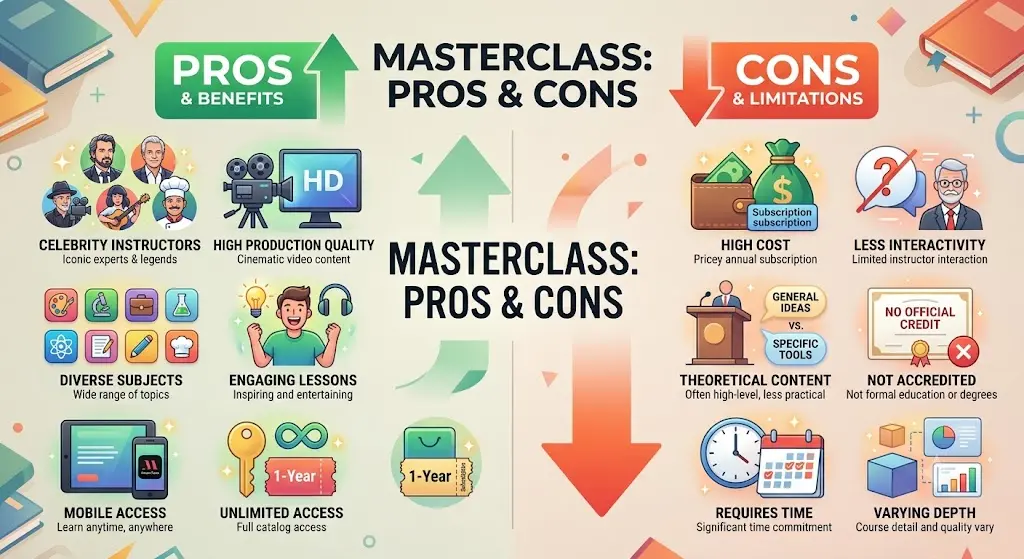
MasterClass Pros and Cons
Pros
- Famous, credible expert instructors
- Excellent, cinematic production quality
- Broad subject selection across dozens of interests
- Fully self-paced learning
- Strong entertainment value — genuinely enjoyable to watch
- Useful supporting resources like Class Guides
Cons
- Annual billing only, no true monthly plan
- Limited certification value for standard classes
- Some courses lean more inspirational than practical
- Course quality varies depending on the instructor
- Not ideal if you need highly technical, career-specific training
MasterClass vs Other Online Learning Platforms
1. MasterClass vs Coursera
Coursera is built around university and industry partnerships, with real certificates and degree pathways. MasterClass has none of that structure but wins on production value and entertainment.
2. MasterClass vs Skillshare
Skillshare leans into project-based creative classes taught by working professionals, not celebrities, often at a lower price point. It’s more hands-on but less polished.
3. MasterClass vs Udemy
Udemy sells individual courses rather than a subscription, so you can buy exactly the skill you need often for technical or software training that MasterClass doesn’t cover.
4. MasterClass vs LinkedIn Learning
LinkedIn Learning is squarely aimed at professional and workplace skills, and completion certificates can be added directly to your LinkedIn profile, a real advantage for career-focused learners.
5. MasterClass vs YouTube
YouTube is free and has an enormous range of tutorials, but lacks the structure, editing, and curated instructor roster that MasterClass offers.
Which platform is best for you?
| Platform | Best for | Certification | Price model |
| MasterClass | Inspiration, broad interests | Limited | Annual subscription |
| Coursera | Career credentials, degrees | Yes | Course or subscription |
| Skillshare | Hands-on creative projects | No | Subscription |
| Udemy | One-off skill purchases | Certificate of completion | Pay per course |
| LinkedIn Learning | Workplace/professional skills | Yes (LinkedIn-linked) | Subscription |
| YouTube | Free, self-directed learning | No | Free |
Who Is MasterClass Best For?
1. Creatives
Writers, cooks, musicians, and photographers get the most out of the catalog’s depth in these areas.
2. Entrepreneurs
Business and leadership courses offer useful mindset frameworks, even if they’re lighter on tactical, step-by-step execution.
3. Hobby learners
If you treat learning as a hobby in itself, the breadth of subjects makes MasterClass genuinely fun to explore.
4. Professionals
Professionals looking for soft-skill development (communication, negotiation, leadership) will find value, though career-specific technical training is better sourced elsewhere.
5. Students
Students can use it as supplementary inspiration alongside formal coursework, but it shouldn’t replace structured academic learning.
6. Lifelong learners
If you just enjoy learning for its own sake and watch a few courses a year, the subscription pays for itself in entertainment value alone.
Who Should Not Buy MasterClass?
People looking for accredited qualifications
MasterClass doesn’t offer accredited degrees or industry-recognized credentials for its standard course library.
People seeking technical certifications
If you need a certificate to prove a skill to an employer, platforms like Coursera or LinkedIn Learning are a better investment.
Learners who want intensive hands-on training
Without instructor feedback or graded assignments, MasterClass isn’t built for skill mastery that requires correction and iteration.
People unlikely to watch several courses
If you only plan to watch one course and cancel, the per-course cost gets expensive fast compared to buying a single course elsewhere.
What Reddit and Customer Reviews Say
I looked at broader sentiment on Reddit and Trustpilot to balance out my own hands-on testing, without treating any single comment as representative of every user’s experience.
Common positive feedback
Users on r/MasterClass and similar communities frequently mention the production quality and the appeal of learning directly from well-known instructors as major draws.
Common complaints
A recurring complaint across customer reviews involves the lack of a true free trial and confusion around the 30-day guarantee only covering first-time purchases, not renewals.
What users disagree about
Opinions split on practicality; some users feel courses deliver real, applicable skills, while others feel the content is closer to entertainment than education.
What customer reviews reveal that marketing pages don’t
Customer reviews are more candid about auto-renewal billing surprises and about certain courses feeling thinner than the marketing suggests, which is useful context marketing pages naturally leave out.
MasterClass Alternatives
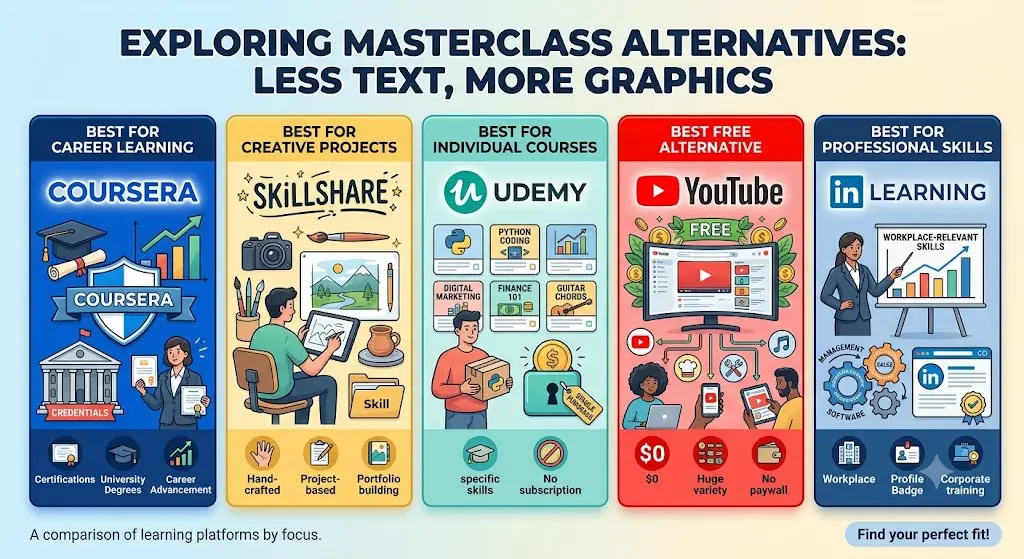
Best alternative for career learning — Coursera
Coursera offers university-backed courses, professional certificates, and even full online degrees for learners who need credentials.
Best alternative for creative projects — Skillshare
Skillshare’s project-based format is a strong fit for creatives who want to build a portfolio piece while learning.
Best alternative for individual courses — Udemy
Udemy lets you buy single courses rather than commit to a subscription, which suits people with one very specific skill gap.
Best free alternative — YouTube
YouTube remains the best free option if budget is the main concern, though you’ll trade away curation and structure.
Best alternative for professional skills — LinkedIn Learning
LinkedIn Learning is the strongest option for workplace-relevant skills, with certificates that connect directly to your professional profile.
How to Decide if MasterClass Is Worth It for You
Choose MasterClass if: you want inspiration, access to genuine experts, broad and varied interests, and you’ll realistically use the subscription frequently throughout the year.
Choose another platform if: you need certification, technical depth, structured career training, or project-based learning with feedback.
Frequently Asked Questions
1. Is MasterClass worth the money?
Yes, if you plan to watch multiple courses and enjoy learning from expert instructors.
It may not be worthwhile if you only need one specific skill.
2. How much does MasterClass cost?
The cost of MasterClass plans is between $120 and $240 each year. This depends on which MasterClass plan you choose.
All MasterClass plans give you access to the library of courses that MasterClass has.
3. Does MasterClass offer a free trial?
No, MasterClass does not currently offer a free trial.
Instead, eligible new members can use its 30-day satisfaction guarantee.
4. Does MasterClass offer certificates?
MasterClass is really about learning and getting inspired. It is not meant for people who want certifications or special qualifications that are officially recognized. MasterClass is better for people who want to learn things, get some inspiration and work on their personal development.
5. Is MasterClass good for beginners?
Yes, many courses are beginner-friendly and easy to follow.
You can learn at your own pace through short video lessons.
6. Can you watch MasterClass offline?
Yes, offline downloads are available with the Plus and Premium plans.
This is useful when traveling or when you have limited internet access.
7. Is MasterClass good for career development?
It can help with soft skills, creativity, leadership, and professional inspiration.
For certifications or technical career training, other platforms may be better.
8. Is MasterClass better than Coursera?
MasterClass is stronger for expert-led and inspirational content.
Coursera is better for structured learning, professional certificates, and degrees.
9. Who should subscribe to MasterClass?
It is best for creatives, hobby learners, entrepreneurs, professionals, and lifelong learners.
You get the most value when you regularly explore multiple courses.
10. Who should not buy MasterClass?
This is not good, for people who want to get certificates or need to learn skills from a teacher.
If you only want to watch one or two classes then it is not worth it.
Conclusion
Overall MasterClass gets a 4 out of 5 stars in my testing. It is not trying to be a university or a bootcamp. Once you stop expecting it to act like one it is easier to appreciate what it actually does well.
The platform’s biggest advantage is the combination of expert instructors and beautiful production few competitors come close on either front. Its biggest drawback is practicality if you need a certificate or hands-on skill-building with feedback, this isn’t the tool for the job.
Value-wise, MasterClass makes sense for people who will actually explore the catalog not just one course and done. At 120 to 240 a year depending on the plan it is a reasonable price if you treat it as a year of ongoing access rather than a one-time purchase.
My final take MasterClass is worth it for self-directed learners who want inspiration and expert access, across a wide range of interests. If you need credentials or technical training put your budget toward Coursera or LinkedIn Learning instead.