
Number Programs in Java
Number programs in Java are simple logic-based programs that work with numerical values to perform operations such as calculations, checks, and transformations. These programs are commonly used to understand how numbers behave when combined with loops, conditions, and mathematical operators. Examples include programs for finding factorials, reversing numbers, checking prime numbers, and identifying special numbers.
For beginners, number programs play a crucial role in building a strong foundation in Java. They help learners understand core concepts like loops, conditional statements, and logical thinking in a practical way. Practicing these programs improves problem-solving skills and makes it easier to handle more complex programming tasks later.
Number programs are widely used in academic exams, coding practice sessions, and technical interviews. Many entry-level Java interviews include such questions to test basic logic and clarity of thought. This guide covers basic number programs, special number programs, and number pattern programs in Java, helping you practice all major categories in one place.
What Are Number Programs in Java?
Number programs in Java are programs that perform operations, checks, or calculations using numerical values. These programs focus on applying logical rules to numbers in order to produce a specific result, such as finding a factorial, checking whether a number is prime, or reversing the digits of a number. They are mainly used to practice and strengthen logical thinking in Java programming.
While writing number programs, a few core programming concepts are used repeatedly:
- Loops: Used to repeat operations, such as processing each digit of a number or running calculations multiple times.
- Conditions: Help in decision-making, for example, checking whether a number satisfies a specific rule.
- Modulus operator (%): Commonly used to extract digits from a number or check divisibility.
- Number manipulation: Involves breaking a number into digits, rearranging them, or performing calculations on individual digits.
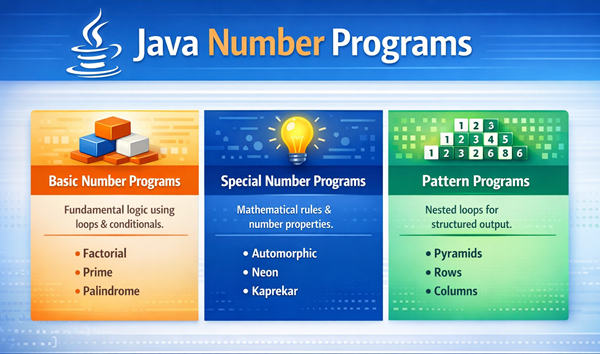
Number programs in Java are generally categorized into basic number programs, special number programs, and number pattern programs, based on the type of logic and output involved.
Categories of Number Programs in Java
Number programs in Java can be grouped into different categories based on the type of logic they use and the kind of output they produce. Understanding these categories makes it easier to learn and practice number-based problems step by step. This page is structured to help you move from simple concepts to more advanced logic in a clear and organized way.
Basic Number Programs
Basic number programs are simple logic-based programs that focus on fundamental Java concepts. These programs mainly use loops and conditional statements to perform operations on numbers. Examples include finding the factorial of a number, reversing a number, checking prime numbers, and identifying palindromes. They are ideal for beginners who are just starting with Java and want to strengthen their logical thinking.
Special Number Programs
Special number programs are based on specific mathematical properties of numbers. Each program follows a defined rule or pattern that determines whether a number belongs to a special category, such as automorphic, neon, or Kaprekar numbers. These programs are commonly asked in academic exams and technical interviews to test problem-solving skills and understanding of number logic.
Number Pattern Programs
Number pattern programs focus on generating structured output patterns using numbers. These programs rely heavily on loop control to arrange numbers in formats like rows, columns, pyramids, or reverse patterns. Practicing number pattern programs helps improve control over nested loops and enhances overall coding confidence in Java.
Basic Number Programs in Java
Basic number programs form the foundation of logical programming in Java. These programs help beginners understand how loops, conditions, and simple arithmetic work together to solve problems. Almost every advanced or special number program is built on the same concepts practiced here, which is why mastering these basics is essential before moving forward.
Below are some of the most important basic number programs every Java learner should practice.
1. Factorial of a Number
A factorial program calculates the product of all positive integers up to a given number. It is commonly used to practice loops and multiplication logic.
Example:
Input: 5
Output: 120
🔗 Read more: Factorial of a number in Java
2. Reverse of a Number
This program reverses the digits of a given number by extracting digits one by one using loops and the modulus operator.
Example:
Input: 1234
Output: 4321
🔗 Read more: Reverse number in Java
3. Prime Number
A prime number program checks whether a given number is divisible only by 1 and itself. It is useful for understanding conditional checks and loop termination.
Example:
Input: 7
Output: Prime Number
4. Palindrome Number
A palindrome number program verifies whether a number remains the same when its digits are reversed. It combines digit manipulation with conditional logic.
Example:
Input: 121
Output: Palindrome Number
Special Number Programs in Java
Special number programs in Java are based on unique mathematical properties that a number must satisfy to belong to a specific category. Each special number follows a predefined rule, and Java programs are written to check whether a given number meets that rule. These programs are commonly used to improve logical thinking and are frequently asked in academic exams, coding practice, and interviews.
Below is a list of commonly practiced special number programs in Java, along with simple definitions and examples.
1. Automorphic Number
A number whose square ends with the same digits as the number itself.
Example: 5 → 25
🔗 Read more: Automorphic Number in Java
2. Neon Number
A number where the sum of digits of its square equals the number itself.
Example: 9 → 81 → 8 + 1 = 9
🔗 Read more: Neon number in Java
3. Kaprekar Number
A number whose square can be split into parts that add up to the original number.
Example: 45 → 2025 → 20 + 25 = 45
🔗 Read more: Kaprekar Number Program in Java
4. Spy Number
A number whose sum of digits is equal to the product of its digits.
Example: 1124 → 1+1+2+4 = 8, 1×1×2×4 = 8
🔗 Read more: Spy number in Java
A number that results in 1 after repeatedly summing its digits until a single digit remains.
Example: 19 → 1 + 9 = 10 → 1 + 0 = 1
6. Buzz Number
A number that is divisible by 7 or ends with the digit 7.
Example: 14 or 27
7. Duck Number
A number that contains at least one zero, excluding leading zeros.
Example: 102
8. Disarium Number
A number where the sum of its digits raised to their respective positions equals the number itself.
Example: 135 → 1¹ + 3² + 5³ = 135
9. Fascinating Number
A number that produces all digits from 1 to 9 exactly once when multiplied by 2 and 3 and concatenated.
Example: 192
10. Pronic Number
A number that is the product of two consecutive integers.
Example: 12 → 3 × 4
11. Niven Number
A number that is divisible by the sum of its digits.
Example: 18 → 1 + 8 = 9, 18 ÷ 9 = 2
12. Smith Number
A composite number whose sum of digits equals the sum of digits of its prime factors.
Example: 666
13. Tech Number
A number with an even number of digits that can be split into two equal parts whose sum, when squared, equals the original number.
Example: 2025 → (20 + 25)² = 2025
14. Special Number
A general category for numbers that satisfy a specific custom-defined condition based on digit operations.
Example: Varies based on definition
Number Pattern Programs in Java
Number pattern programs in Java focus on generating structured outputs using numbers arranged in specific formats. These programs do not perform calculations on numbers but instead concentrate on how numbers are displayed using loops and conditional logic. Number patterns are widely used to help learners understand the flow of execution in loops and how nested loops work together.
Practicing number pattern programs is especially important for improving control over loop logic and output formatting. They help beginners visualize how loops repeat and how changing loop conditions affects the final output. This makes them an excellent exercise for mastering Java fundamentals.
Common Types of Number Patterns
- Simple number patterns: Basic patterns that display numbers in rows or columns using single or nested loops.
- Pyramid patterns: Structured patterns where numbers form pyramid or triangle shapes, commonly used to practice nested loops.
- Reverse number patterns: Patterns where numbers are displayed in reverse order or descending formats, helping improve loop control and logic.
How to Approach Number Programs in Java
Approaching number programs in Java with a clear method makes problem-solving easier and reduces mistakes. Instead of jumping straight into coding, it’s important to understand the logic behind the problem and plan your steps.
- Understand the problem definition: Read the problem carefully and identify what needs to be calculated or checked. Pay attention to input, expected output, and any specific conditions mentioned.
- Break the number using logic: Many number programs require working with individual digits. Use logical steps such as extracting digits, summing values, or rearranging numbers before writing the code.
- Use loops carefully: Loops are often the core of number programs. Decide whether a
for,while, ordo-whileloop is best suited for the task, and ensure loop conditions are correct to avoid infinite loops. - Dry run with examples: Before running the program, manually trace the logic with sample inputs. Dry running helps verify correctness and makes debugging much easier.
Following this step-by-step approach helps build confidence and improves accuracy while writing number programs in Java.
Why Practice Number Programs in Java?
Practicing number programs in Java plays an important role in building a strong programming foundation. These programs may look simple, but they help develop essential skills that are used across all areas of Java development.
- Improves logical thinking: Number programs train your mind to break problems into smaller steps and apply logical rules to reach a solution.
- Strengthens loop concepts: Most number programs rely heavily on loops. Regular practice improves your understanding of loop control, conditions, and iteration flow.
- Helps in interviews and exams: Many academic exams and entry-level Java interviews include number-based questions to test basic logic and problem-solving ability.
- Builds confidence in Java fundamentals: Successfully solving number programs increases confidence in using core Java concepts like variables, conditions, and loops.
Consistent practice of number programs makes it easier to progress to more advanced programming topics.
Frequently Asked Questions
What are number programs in Java?
Number programs in Java are logic-based programs that perform operations or checks using numerical values. They are mainly used to practice loops, conditional statements, and number manipulation techniques such as extracting digits or performing calculations.
Which number programs are important for beginners?
Beginners should start with basic number programs such as factorial of a number, reverse of a number, prime number check, and palindrome number programs. These help build a strong foundation in loops and conditional logic.
Are special number programs asked in interviews?
Yes, special number programs are often asked in academic exams and entry-level Java interviews. These questions test a candidate’s understanding of logic, mathematical properties, and problem-solving skills.
How many number programs should I practice in Java?
There is no fixed number, but beginners should practice at least 15–20 number programs covering basic, special, and pattern-based categories. Regular practice across different types of problems improves logical thinking and coding confidence.
Are number pattern programs important for Java beginners?
Yes, number pattern programs are important for beginners because they improve understanding of loops and nested loop structures. They also help learners visualize how loop conditions control program output.
Conclusion
Number programs in Java are an essential part of learning and mastering core programming concepts. They help build logical thinking, improve problem-solving skills, and strengthen understanding of loops, conditions, and number manipulation. For beginners, practicing number programs creates a solid foundation that supports more advanced Java topics.
To get the most value, start with basic number programs to understand fundamental logic, then move on to special number programs that introduce mathematical conditions, and finally practice number pattern programs to gain confidence with loops and output formatting. This step-by-step approach makes learning structured and effective.