
Java remains one of the most popular programming languages due to its simplicity, security, and platform independence. Built on the “Write Once, Run Anywhere” principle, it allows developers to create applications that run seamlessly across different systems using the Java Virtual Machine (JVM).
With features like object-oriented design, multithreading, high performance, and a rich standard library, Java is widely used in web development, enterprise systems, Android apps, and cloud computing. This blog explores the key features of Java and why it continues to be a reliable choice for modern software development.
What Is Java?
Java is a high-level, object-oriented, and class-based programming language originally developed by Sun Microsystems and later acquired by Oracle Corporation. It was designed to be simple, secure, robust, and easy to use, allowing developers to build reliable applications without dealing with low-level system complexities. Java’s object-oriented structure is based on classes and objects, which helps in creating modular, reusable, and well-organized code using concepts like encapsulation, inheritance, polymorphism, and abstraction.
One of Java’s most important strengths is its platform independence, achieved through the Java Virtual Machine (JVM). Java source code is compiled into bytecode, which can run on any operating system that supports a JVM, following the principle of Write Once, Run Anywhere. Java also offers strong security features, automatic memory management through garbage collection, and effective exception handling, making it a robust and dependable choice for developing enterprise, web, mobile, and cloud-based applications.
Java follows the philosophy:
“Write Once, Run Anywhere (WORA)”
This means Java programs can run on any device or operating system that supports the Java Virtual Machine (JVM), without requiring changes to the source code.
Why Learn Java?
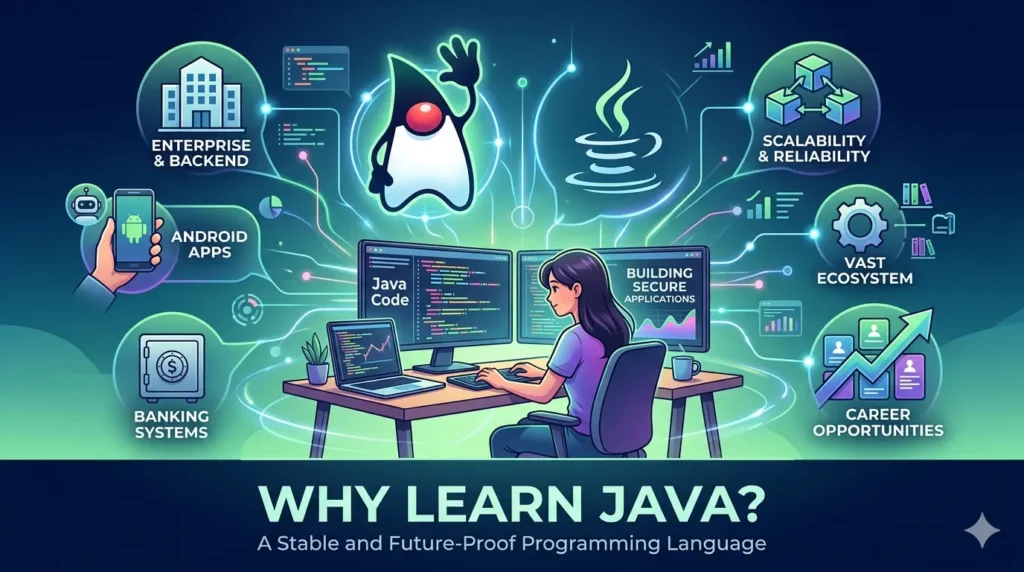
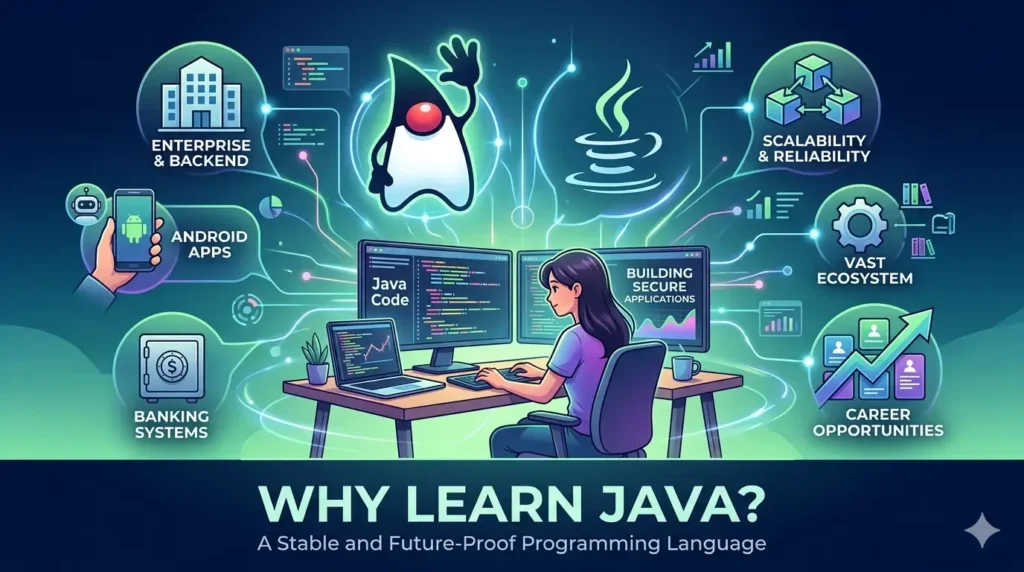
Java continues to be one of the most relevant programming languages in the software industry despite the emergence of many modern alternatives. Its reliability, scalability, and long-term industry adoption make it a preferred choice for both beginners and experienced developers. Java is widely used in building secure, high-performance, and large-scale applications across various domains. Learning Java provides a strong foundation in programming concepts and opens doors to diverse career opportunities.
- Used by millions of developers worldwide
- High demand in enterprise and backend development
- Powers Android apps, banking systems, and large-scale platforms
- Supported by a vast ecosystem of libraries and frameworks
- Offers excellent career and job growth opportunities
Because of these strengths, Java remains a stable and future-proof programming language.
Java Architecture Overview
Understanding Java’s architecture is essential because it explains how Java achieves platform independence, security, and high performance. Java follows a layered architecture in which source code is transformed into an intermediate form and then executed by the Java Virtual Machine (JVM). This design allows Java programs to run consistently across different operating systems and hardware platforms while maintaining reliability and efficiency.
Components of Java Architecture
1. Java Source Code (.java)
Java source code is written by developers using Java’s syntax and object-oriented principles. This code is human-readable and contains classes, methods, variables, and logic required to build an application. Source code files are saved with the .java extension and cannot be executed directly by the system.
2. Java Compiler (javac)
The Java compiler, known as javac, converts the .java source files into bytecode. During compilation, it checks for syntax errors and enforces Java’s strong type rules. Unlike traditional compilers, javac does not generate machine-specific code, which helps Java remain platform-independent.
3. Bytecode (.class)
Bytecode is the intermediate code generated after compilation and stored in .class files. It is not tied to any specific operating system or hardware, making it portable. Bytecode acts as a bridge between the Java source code and the system where the program will run.
4. Java Virtual Machine (JVM)
The JVM is the core of Java’s architecture. It interprets and executes the bytecode on the host system. The JVM manages memory, handles garbage collection, ensures security, and optimizes performance using techniques like Just-In-Time (JIT) compilation. Each operating system has its own JVM implementation, but all JVMs follow the same standards, ensuring consistent execution.
5. Java Runtime Environment (JRE)
The Java Runtime Environment provides everything required to run Java applications. It includes the JVM along with core Java class libraries and supporting files. While the JRE allows users to execute Java programs, it does not include tools for development such as compilers or debuggers.
6. Java Development Kit (JDK)
The JDK is a complete package for Java developers. It includes the JRE along with development tools such as the Java compiler (javac), debugger, documentation generator, and other utilities. The JDK is essential for writing, compiling, testing, and running Java applications.
Key Features of Java Programming Language
Java provides a rich set of features that make it secure, reliable, and platform-independent. These features help developers build scalable and high-performance applications across various environments.
1. Platform Independence
What Is Platform Independence?
Platform independence refers to Java’s ability to run the same program on different operating systems such as Windows, Linux, and macOS without requiring any changes to the source code. Unlike many programming languages that depend on the underlying hardware or operating system, Java applications behave consistently across platforms. This feature allows developers to write a program once and execute it anywhere, making Java highly flexible and widely usable.
How Java Achieves Platform Independence
Java achieves platform independence through its unique compilation and execution process. Java source code is first compiled into an intermediate form called bytecode, rather than being converted directly into machine-specific code. This bytecode is executed by the Java Virtual Machine (JVM), which acts as a bridge between the Java program and the operating system. Each operating system has its own JVM implementation, but all JVMs understand the same bytecode, ensuring that Java programs run the same way on any platform.
Benefits of Platform Independence
- Eliminates the need to rewrite or modify code for different operating systems
- Reduces overall development time and long-term maintenance costs
- Simplifies application deployment across multiple environments
- Makes Java an ideal choice for cross-platform, enterprise, and cloud-based applications
Platform independence is one of the key reasons Java is trusted for building scalable and portable software systems.
2. Object-Oriented Programming (OOP)
Java is a fully object-oriented programming language, except for its primitive data types, which are used for performance optimization. Object-oriented programming allows developers to structure programs around objects and classes, making code more organized, reusable, and easier to maintain. By following OOP principles, Java enables the development of large and complex applications in a systematic and manageable way.
Core OOP Concepts in Java
Encapsulation: Encapsulation binds data and methods into a single unit (class), protecting data from unauthorized access.
Inheritance: Inheritance allows a class to acquire properties and behaviors of another class, promoting code reuse.
Polymorphism: Polymorphism enables methods to behave differently based on the object that calls them.
Abstraction: Abstraction hides complex implementation details and shows only essential features.
Why OOP Matters
- Improves code maintainability by organizing programs into logical structures
- Makes applications scalable and easier to expand over time
- Simplifies debugging and testing by isolating issues within objects
- Enhances code reusability and reduces development effort
Object-oriented programming is a core reason why Java is widely used for building robust, scalable, and enterprise-level applications.
3. Simple and Easy to Learn
Java was designed to be simpler and more user-friendly than complex programming languages like C and C++. Its syntax is clean, logical, and easy to understand, allowing developers to focus on problem-solving rather than low-level system details. By removing many complicated features and providing built-in support for common programming tasks, Java makes application development more straightforward and less error-prone.
Features That Make Java Simple
- No pointer manipulation: Java eliminates direct pointer usage, reducing memory-related errors and improving program safety.
- Automatic memory management: The garbage collector handles memory allocation and deallocation automatically, freeing developers from manual memory handling.
- Clear and readable syntax: Java’s syntax is similar to English and follows strict rules, making code easier to read and maintain.
- Extensive documentation: Java offers rich documentation, tutorials, and community resources that simplify learning and problem-solving.
Who Can Learn Java Easily?
- Beginners starting their programming journey
- Students learning object-oriented programming concepts
- Developers transitioning from other programming languages
Java successfully balances simplicity with powerful features, making it an ideal language for both learning and professional software development.
4. Secure
Security is one of Java’s strongest features, which makes it a preferred choice for enterprise, financial, and mission-critical applications. Java was designed with security in mind from the beginning, helping protect systems from unauthorized access, malicious code, and common programming vulnerabilities. Its built-in security model ensures that applications run in a controlled and safe environment.
Java Security Mechanisms
- No direct pointer access: Java does not allow direct memory access through pointers, which helps prevent memory corruption and reduces the risk of security breaches.
- Bytecode verification: Before execution, Java bytecode is verified to ensure it follows language rules and does not perform illegal operations, protecting the system from harmful code.
- Security Manager: The Security Manager defines and enforces security policies, controlling access to critical system resources such as files, network connections, and hardware devices.
- ClassLoader: The ClassLoader separates and isolates classes from different sources, preventing unauthorized code from interfering with core system classes.
Why Java Is Trusted
Java is widely used in environments where security is critical, including:
- Banking and financial systems
- Online payment gateways
- Government and public-sector applications
These strong security features make Java highly suitable for developing applications that handle sensitive data and require a secure execution environment.
5. Robust
Java is designed to build reliable and error-resistant applications by effectively handling errors and preventing system failures. Its robust nature helps applications run smoothly even in unexpected situations, making Java a dependable choice for large-scale and long-running software systems. By detecting issues early and managing resources efficiently, Java minimizes crashes and improves overall stability.
Robust Features in Java
- Strong type checking: Java enforces strict type rules at compile time, reducing type-related errors during program execution.
- Automatic garbage collection: Memory is managed automatically, preventing memory leaks and freeing unused objects without developer intervention.
- Exception handling mechanism: Java provides a structured way to handle errors using try, catch, and finally blocks.
- Runtime error detection: Many errors are detected at runtime, allowing programs to fail gracefully instead of crashing abruptly.
Example of Robustness
Java forces developers to handle exceptions explicitly, which reduces unexpected crashes and improves application reliability. This makes Java especially suitable for developing stable, enterprise-level, and mission-critical applications.
6. Automatic Memory Management
Java provides automatic memory management, which means developers do not need to manually allocate or deallocate memory. This task is handled by the Garbage Collector (GC), a built-in feature of the Java Virtual Machine (JVM). By managing memory automatically, Java reduces common programming errors and allows developers to focus more on application logic rather than system-level details.
How Garbage Collection Works
- Automatically identifies objects that are no longer in use
- Removes unused objects from memory
- Frees memory without requiring any developer intervention
- Helps prevent memory leaks and out-of-memory errors
The Garbage Collector runs in the background and ensures efficient memory utilization throughout the program’s lifecycle.
Advantages
- Less error-prone compared to manual memory management
- Improves overall application stability and performance
- Reduces the risk of memory-related bugs
- Saves development time and effort
Automatic memory management is a key reason Java is considered a safe and reliable language for building large and complex applications.
7. Multithreaded
Java supports multithreading, which allows multiple tasks to execute simultaneously within a single program. This capability enables applications to perform several operations at the same time, improving responsiveness and overall performance. Multithreading is especially useful in applications that require efficient handling of multiple users or tasks concurrently.
What Is Multithreading?
Multithreading is a programming technique where a single process is divided into multiple threads, each executing independently. In Java, threads share the same memory space, allowing faster communication and better resource utilization while performing parallel tasks.
Benefits of Multithreading
- Improves application performance by executing tasks in parallel
- Ensures efficient utilization of CPU resources
- Enhances responsiveness of applications
- Ideal for real-time, interactive, and high-performance systems
Use Cases
- Web servers handling multiple client requests
- Games requiring smooth animations and background processing
- Chat and messaging applications managing multiple users simultaneously
Multithreading makes Java well-suited for building fast, responsive, and scalable applications.
8. High Performance
Although Java uses bytecode instead of directly compiling programs into machine-specific code, it delivers high performance through advanced runtime optimizations. Modern Java applications benefit from the Just-In-Time (JIT) Compiler, which is part of the Java Virtual Machine (JVM). This allows Java to achieve performance levels that are comparable to many traditionally compiled languages.
How JIT Improves Performance
- Converts bytecode into native machine code at runtime: Instead of interpreting bytecode line by line, the JIT compiler translates frequently executed bytecode into native machine code, allowing faster execution.
- Optimizes frequently used code: The JIT identifies “hot spots” in the program code that runs repeatedly and applies advanced optimizations to improve speed and efficiency.
- Reduces execution time: By eliminating repeated interpretation and applying runtime optimizations, the JIT significantly reduces overall program execution time.
9. Distributed
Java is designed to support distributed computing, where different parts of an application run on multiple machines connected through a network. This capability allows Java applications to communicate, share resources, and work together seamlessly across different systems. Distributed features make Java highly suitable for building scalable, network-based, and enterprise-level applications.
Distributed Features in Java
- Networking libraries: Java provides powerful networking APIs such as java.net, which support communication using protocols like HTTP, TCP, and UDP.
- Remote Method Invocation (RMI): RMI allows a Java program to invoke methods on objects located on different machines, making remote communication simple and object-oriented.
- Web services support: Java supports SOAP and REST-based web services, enabling interoperability between different systems and technologies.
Why It Matters
Java’s distributed capabilities make it ideal for building:
- Cloud-based applications that run across multiple servers
- Microservices architectures where services communicate over networks
- Large-scale distributed enterprise systems
These features allow Java applications to scale efficiently, handle high traffic, and operate reliably in modern distributed environments.
10. Architecture Neutral
Java is considered architecture neutral because its programs are not dependent on any specific processor or hardware architecture. This means Java applications behave consistently across different devices, regardless of whether they are running on systems with varying CPU designs. Architecture neutrality plays a key role in Java’s portability and cross-platform capabilities.
Why Java Is Architecture Neutral
- Fixed-size primitive data types: Java defines fixed sizes for primitive data types such as int, float, and double, ensuring consistent behavior and calculations across different hardware platforms.
- Bytecode execution via JVM: Java programs are compiled into platform-independent bytecode, which is executed by the Java Virtual Machine (JVM). Since each platform has its own JVM implementation, the same bytecode can run without modification on different processor architectures.
11. Portable
Portability in Java means that programs can be easily transferred and executed across different environments without requiring code changes. This feature allows Java applications to run smoothly on various operating systems and hardware setups, making deployment and maintenance much simpler, especially in large and complex systems.
What Makes Java Portable?
- Platform-independent bytecode: Java programs are compiled into bytecode, which can run on any system that has a compatible Java Virtual Machine (JVM).
- Standardized libraries: Java provides a consistent set of standard libraries that behave the same way across platforms, ensuring uniform functionality.
- Consistent execution environment: The JVM offers a uniform runtime environment, so Java applications perform consistently regardless of the underlying system.
Portability is especially crucial for large organizations that manage diverse systems, as it reduces compatibility issues and simplifies application deployment across multiple platforms.
12. Dynamic
Java supports dynamic behavior, allowing classes to be loaded, linked, and used at runtime rather than at compile time. This flexibility enables applications to adapt while they are running, making Java suitable for modern, modular, and extensible software systems.
Dynamic Capabilities
- Reflection API: Java’s Reflection API allows programs to inspect and manipulate classes, methods, and fields at runtime, even if their details were not known at compile time.
- Dynamic class loading: Java can load classes dynamically as needed, which helps reduce initial startup time and supports modular application design.
- Runtime linking: Classes are linked during runtime, allowing applications to incorporate new components or updates without recompilation.
Benefits
- Enables flexible and extensible application design
- Supports plugin-based and modular architectures
- Allows applications to adapt to changing requirements at runtime
These dynamic features make Java a powerful choice for building adaptable, scalable, and future-ready applications.
13. Rich Standard Library
Java provides a rich and extensive standard library that supports a wide range of programming tasks. These built-in libraries offer ready-to-use classes and methods, allowing developers to implement complex functionality without writing code from scratch. This significantly reduces development time and improves overall productivity.
Popular Java Libraries
- java.lang: Contains fundamental classes such as Object, String, Math, and Thread, which are essential for basic program execution.
- java.util: Provides utility classes for data structures like lists, sets, maps, date and time handling, and collections framework.
- java.io: Supports input and output operations, including file handling and stream-based data processing.
- java.net: Enables networking capabilities such as URL handling, sockets, and network communication.
- java.sql: Provides APIs for database connectivity and executing SQL queries.
These libraries make Java development faster, more efficient, and reliable, allowing developers to focus on building high-quality applications rather than low-level implementation details.
Java in Modern Development
Java continues to evolve with regular updates, ensuring it stays relevant in today’s fast-changing technology landscape. With new language features, performance improvements, and enhanced security, modern Java supports contemporary development practices while maintaining backward compatibility. This ongoing evolution allows developers to build efficient, scalable, and future-ready applications.
Modern Java Use Cases
- Web applications: Java is widely used for building robust web applications using frameworks like Spring and Hibernate, which simplify development, improve security, and support scalable architectures.
- Android development: Java remains one of the core languages for Android app development, powering millions of mobile applications worldwide.
- Cloud computing: Java is well-suited for cloud environments due to its scalability, portability, and strong support for containerization and cloud-native frameworks.
- Big data platforms: Java is extensively used in big data technologies such as Hadoop and Apache Spark, enabling efficient processing of large datasets.
- Microservices: Java supports microservices architecture through lightweight frameworks, allowing developers to build modular, independently deployable services.
By adapting to modern development trends and technologies, Java remains a powerful and dependable choice for building applications across diverse domains.
Advantages of Java Programming Language
Java offers numerous advantages that make it one of the most popular and widely used programming languages in the world. Its powerful features, reliability, and long-term industry adoption make it suitable for a wide range of applications, from small programs to large enterprise systems.
- Platform independent: Java follows the Write Once, Run Anywhere principle, allowing programs to run on different operating systems without modification. This reduces development effort and simplifies deployment across multiple platforms.
- Secure and robust: Java includes built-in security features such as bytecode verification, a security manager, and automatic memory management. Strong exception handling and garbage collection make Java highly robust and resistant to system failures.
- Scalable and reliable: Java is designed to handle large-scale applications efficiently. Its support for multithreading, distributed computing, and enterprise frameworks makes it highly scalable and reliable for long-term use.
- Strong community support: Java has a vast global community of developers, extensive documentation, open-source libraries, and frameworks. This support makes learning, troubleshooting, and development easier and faster.
- High demand in the job market: Java skills are in strong demand across industries such as finance, healthcare, e-commerce, and technology. This creates excellent career opportunities and long-term job stability for Java developers.
These advantages make Java a dependable and future-proof programming language for modern software development.
Limitations of Java
Despite its many strengths, Java also has some limitations that developers should be aware of. These drawbacks are mainly related to performance and code verbosity, especially when compared to some newer programming languages.
- Slower startup time: Java applications may take longer to start because of JVM initialization and class loading, which can be noticeable in small or lightweight applications.
- Verbose syntax: Java often requires more lines of code to perform simple tasks, making programs longer and sometimes harder to read compared to more concise languages.
- Higher memory usage: Java applications can consume more memory due to the JVM and garbage collection processes.
However, modern Java versions continue to improve performance, reduce verbosity, and optimize memory usage, helping to minimize these limitations over time.
Java vs Other Programming Languages
Java stands out when compared to many other programming languages because of its balanced approach to performance, security, and scalability. While each language has its own strengths, Java offers a combination of features that make it especially suitable for large-scale and enterprise-level applications.
- Better portability than C++: Unlike C++, which requires platform-specific compilation, Java uses platform-independent bytecode executed by the JVM, allowing programs to run seamlessly across different operating systems.
- Stronger OOP structure than Python: Java enforces a strict object-oriented structure, making it easier to design well-organized, maintainable, and scalable applications, especially for large projects.
- Greater enterprise adoption than many newer languages: Java is widely used in enterprise environments due to its stability, security, and long-term support, giving it an edge over many newer or less mature languages.
This balance of portability, performance, security, and scalability keeps Java competitive and highly relevant in modern software development.
Career Opportunities with Java
Java developers are in high demand across a wide range of industries due to Java’s reliability, scalability, and enterprise-level adoption. Mastering Java opens opportunities in both traditional and modern technology domains.
- Software development: Building desktop, web, and enterprise-level applications
- Backend engineering: Developing APIs, microservices, and server-side systems
- Android development: Creating mobile applications for the Android ecosystem
- Enterprise systems: Working on banking software, ERP systems, and business platforms
- Cloud computing: Developing cloud-native applications and distributed systems
- Big data engineering: Working with technologies like Hadoop, Spark, and data processing frameworks
- DevOps engineering: Supporting CI/CD pipelines, automation tools, and cloud infrastructure using Java-based tools
- Game development: Building server-side game logic and multiplayer backends
- FinTech development: Creating secure financial applications, payment systems, and trading platforms
- QA and Automation Testing: Developing automated test frameworks using Java tools like Selenium and TestNG
With its wide applicability and strong job market demand, Java offers diverse career paths and long-term professional growth opportunities.
Conclusion
Understanding the key features of the Java programming language provides a strong foundation for mastering modern software development. Java’s platform independence, object-oriented design, security, robustness, and scalability make it a powerful and reliable choice for developers at all levels.
Whether you are a beginner learning programming or a professional building enterprise systems, Java remains a language worth investing time and effort in.
Frequently Asked Questions (FAQs) about Java
1. Is Java still relevant in 2026?
Yes. Java remains one of the most widely used programming languages, especially in enterprise software, cloud applications, microservices, and Android development.
2. Why is Java called platform-independent?
Java programs are compiled into bytecode, which runs on the Java Virtual Machine (JVM). Any system with a JVM can execute Java programs regardless of the underlying hardware or operating system.
3. Is Java suitable for beginners?
Yes. Java has a clear syntax, strong documentation, and extensive community support, making it an excellent choice for beginners learning programming and object-oriented concepts.
4. What is the difference between JDK, JRE, and JVM?
- JVM: Executes Java bytecode
- JRE: JVM + core libraries required to run Java applications
- JDK: JRE + development tools for building Java applications
5. Can Java be used for modern applications?
Absolutely. Java is widely used for cloud-native applications, microservices, REST APIs, big data processing, and distributed systems.
6. Is Java faster than Python?
Yes. Java generally offers better runtime performance than Python due to compilation into bytecode and JIT optimizations.
7. What are the career prospects for Java developers?
Java developers are in high demand for roles such as backend developer, Android developer, cloud engineer, enterprise architect, and big data engineer.
8. What are the limitations of Java?
Java can have a slower startup time, higher memory usage, and verbose syntax, but modern JVM improvements continue to reduce these drawbacks.