
If you’ve searched “Foxfiny com” and landed on a pile of contradictory answers, you’re not imagining it. One article calls it an e-commerce store, another calls it a “fintech platform,” and a third insists it’s some kind of AI tool. After spending time on the actual site, checking its structure, and cross-referencing third-party trust data, I can tell you what’s true: Foxfiny.com is a general-interest content blog, not a store, not a bank, and not an investment platform. This guide walks through exactly what it is, how it works, and how to judge its content safely, using only what can be verified directly rather than recycled guesswork.
What Is Foxfiny Com?
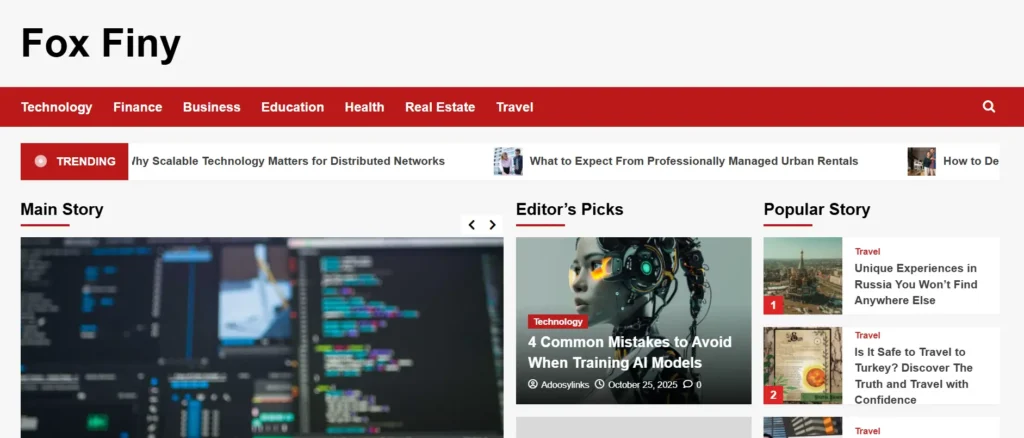
Foxfiny.com (branded on-site simply as “Fox Finy”) is a WordPress-powered online magazine that publishes articles across finance, technology, business, education, health, real estate, and travel. It reads like a typical digital publication, with a homepage grid of recent posts, category pages, and an archive going back to 2022, rather than anything transactional.
Foxfiny.com at a glance
| Attribute | Details |
| Website | Foxfiny.com (also appears as www.foxfiny.com) |
| Brand name shown on-site | “Fox Finy” |
| Website type | Content blog / online magazine (WordPress, running the CoverNews theme) |
| Main purpose | Publishing informational and lifestyle articles |
| Content categories | Technology, Finance, Business, Education, Health, Real Estate, Travel |
| Account required | No, content is publicly readable, no login or signup observed |
| Financial transactions | None observed, the site does not process payments or sell products |
| AI tools | None found on the site; not an AI platform |
| Ownership | Not disclosed by name; posts are published under a shared byline (“Adoosylinks”) |
| Security | Loads over HTTPS |
What Foxfiny.com actually offers
In practice, Foxfiny.com offers what any content site offers: articles. Categories like Finance and Real Estate contain explainer-style posts, think “MT4: A Beginner’s Guide,” “Cibil Score: Unleashing the Power of Credit Worthiness,” or pieces on rental property management and vision checkups. There’s no shopping cart, no dashboard, no account area, and no calculator or AI tool anywhere in the visible site structure.
Is Foxfiny a blog, platform, or financial service?
It’s a blog. The word “platform” gets thrown around loosely online, and some low-quality review sites have stretched it to mean “financial platform” or even “e-commerce platform.” Based on direct inspection, Foxfiny.com is neither. It functions the same way thousands of niche WordPress magazines do: publish articles, run ads, and monetize through guest-post and link placements.
Why are there conflicting descriptions online?
This is the most important thing to understand before you read anything else about Foxfiny.com. A search for “Foxfiny.com” turns up several low-effort, templated review articles that describe it as an online shopping site with “trendy fashion” and “seasonal deals,” while others describe it as a fintech or investment platform with “customer support” and “payment methods.” Neither matches what the actual site shows. These appear to be generic scam-checker templates reused across many unrelated domains, swapping in the site name without verifying the content. That’s a useful lesson on its own: when you’re researching any unfamiliar website, always weigh what you see with your own eyes on the domain itself over what a copy-paste “review” site claims.
How Does Foxfiny.com Work?
1. How visitors access the website
You reach Foxfiny.com the same way you’d reach any blog: by typing the URL, clicking a search result, or following a link from another site. There’s no app, no download, and no registration wall blocking content.
2. How content is organized
The homepage displays a “Trending,” “Main Story,” “Editor’s Picks,” and “Popular Story” layout typical of magazine-style WordPress themes, with a persistent top navigation bar linking to each category.
3. How users find articles
Discovery happens mainly through a built-in search box, category browsing, and an archive organized by month and year going back to 2022. Organic search traffic (people arriving from Google) is the most obvious pathway, since many posts are written around specific search queries.
4. Does Foxfiny require an account?
No. Every article checked was fully readable without logging in or creating a profile.
5. Does Foxfiny offer interactive tools?
No calculators, quizzes, AI chat tools, or financial dashboards were found anywhere on the site. It is a static-article publishing setup, not an interactive product.
What Topics Does Foxfiny.com Cover?
Based on the live category menu, Foxfiny.com covers:
- Finance: credit scores, credit cards, trading platforms like MetaTrader (MT4), and general money-management explainers
- Technology: cloud computing, AI training pitfalls, and networking topics
- Business: general business strategy and operations content
- Education: study tips and learning-related guides
- Health: general wellness topics such as eye checkups and home remedies
- Real Estate: rental property management, tenant screening, and home-buying comparisons
- Travel: destination guides and travel-safety pieces
These are the only categories confirmed through direct navigation of the site as of this review; anything beyond this list found on third-party sites should be treated as unverified.
Is Foxfiny.com a Financial Platform?
1. What the website actually shows
The Finance category is filled with educational, blog-style articles, not account dashboards, trading interfaces, or payment forms. Nothing on the site processes a transaction.
2. What third-party websites claim
Some low-quality review sites describe Foxfiny.com in language borrowed from fintech reviews, mentioning “customer support,” “payment methods,” or “platform transparency policies”, without pointing to anything specific on the actual site that supports those claims. Treat this kind of description with caution.
3. Does Foxfiny offer financial transactions?
No evidence of this was found. There’s no checkout, no wallet, no deposit or withdrawal function anywhere in the visible site.
4. Does Foxfiny offer investment tools?
No. Articles may explain concepts like trading platforms or credit scores in general terms, but explaining a topic is different from offering the tool itself.
5. Does Foxfiny provide personalized financial advice?
No. Content reads as general, non-personalized educational writing, the kind you’d expect from any finance blog, not licensed financial advice tailored to an individual’s situation.
6. What users should verify before trusting financial claims
Before acting on any money-related article from Foxfiny.com or a similar blog, cross-check the specific numbers or product claims against an official source, your bank, a regulator’s website, or a licensed advisor. General blogs are a starting point for learning, not a substitute for professional guidance.
Is Foxfiny.com Legit?
“Legit” is often the wrong question for a content blog. The better question is whether it’s transparent and trustworthy as a publisher. Here’s the honest breakdown.
1. Website identity
The site presents itself under the “Fox Finy” brand with a straightforward magazine layout. There’s nothing deceptive about the visible design, it doesn’t mimic a bank or impersonate a known brand.
2. Ownership transparency
This is the weak point. No named editorial team, company, or individual owner is visible on the homepage. Every article is credited to the same generic author account rather than an individual writer with a bio.
3. Contact information
The only contact method found is an obfuscated email link in the sidebar. There’s no visible phone number, mailing address, or “About Us” page linked from the main navigation.
4. Author information
Articles are published under a single shared byline rather than named subject-matter experts. That matters for trust: a finance or health article carries more weight when you can see who wrote it and what qualifies them to write it.
5. Content sourcing
Posts generally read as original explainer content, but citations to primary sources (studies, regulators, official data) are limited or absent in the pages reviewed.
6. Website policies
No clearly linked privacy policy, terms of use, or editorial standards page was found in the main navigation at the time of this review. That’s worth noting for anyone concerned about how a site handles visitor data.
7. Domain information
Third-party domain-checking tools note that foxfiny.com is a relatively young, recently active domain. Independent site-scanning service ScamAdviser reported that the domain was registered fairly recently and that its automated trust score was on the lower side at the time of checking, while also noting that most scam operators abandon a domain rather than keep renewing it once a scam becomes public knowledge. ScamAdviser’s own guidance is to treat automated scores as one signal among several rather than a final verdict.
8. Overall legitimacy assessment
Foxfiny.com behaves like a real, functioning content blog rather than a storefront or scam operation. There’s no checkout, no fake urgency countdown, and no request for payment anywhere in its structure. At the same time, it lacks the transparency markers (named authors, an About page, clear policies) that stronger publishers show. A fair, evidence-based read: it appears to be a legitimate but low-transparency content site, not a fraudulent one, though visitors should apply normal skepticism to anything it publishes.
Is Foxfiny.com Safe to Use?
1. HTTPS and connection security
The site loads over HTTPS, which encrypts the connection between your browser and the server. That’s a basic but important baseline for any modern website.
2. Personal information
No forms requesting personal or financial details were found on the pages reviewed, which limits your exposure simply by browsing.
3. Account and login safety
There’s no account system to worry about, since no login or signup exists on the site.
4. Payment information
No payment fields exist anywhere on Foxfiny.com, so there’s no risk of entering card details on the site itself.
5. Downloads and external links
Some articles include outbound links to other sites (including sponsored or guest-post links, more on that below). Treat any link that leads off-domain, especially ones prompting a download, with the same caution you’d apply anywhere else on the web.
6. Redirects and pop-ups
No aggressive pop-ups or forced redirects were encountered during review, though ad-supported sites can vary in behavior depending on your location and ad blocker settings.
7. Privacy considerations
Because no clear privacy policy is linked, it’s not possible to confirm exactly what analytics or advertising trackers the site uses. If that matters to you, browse with a privacy-focused browser extension or ad blocker.
8. Safe browsing practices
Treat Foxfiny.com the way you’d treat any general blog: fine to read, but don’t enter payment details, don’t download unexpected files, and verify anything important (medical, legal, or financial) elsewhere.
Foxfiny.com Content Quality Review
1. Accuracy
Articles are written in plain, accessible language and generally stay factually reasonable on the surface, but claims aren’t consistently backed by cited sources, so accuracy can’t be independently confirmed article by article.
2. Depth
Coverage tends toward introductory-level explainers rather than in-depth, data-heavy analysis. Good for a first read on a topic; not a substitute for specialist research.
3. Author expertise
Because posts share a single generic byline instead of named, credentialed writers, there’s no way to verify the expertise behind any individual article, a notable gap, especially for health and finance content.
4. Sources and citations
Limited. Most articles reviewed did not link out to primary data, studies, or official sources to support their claims.
5. Update frequency
The archive shows a steady publishing cadence into 2026, suggesting the site is actively maintained rather than abandoned.
6. Editorial transparency
Low. No visible editorial guidelines, correction policy, or fact-checking process is described on the site.
7. Who should use the content?
Casual readers looking for a plain-English introduction to a topic, what a CIBIL score is, how MT4 works at a basic level, what to consider when comparing new construction versus resale homes.
8. When should you verify information elsewhere?
Anytime the topic involves money, health, or legal decisions. For those categories, treat Foxfiny.com as a starting point for vocabulary and context, then confirm specifics with an official or licensed source, a bank, doctor, regulator, or accredited financial advisor.
Foxfiny.com Features and Website Experience
1. Website design
Clean, magazine-style layout using the CoverNews WordPress theme, with featured images, category tags, and a scannable homepage grid.
2. Navigation
A persistent top menu lists all seven categories, making it easy to jump between topics without hunting through the homepage feed.
3. Mobile experience
The theme is responsive and adjusts to smaller screens, consistent with standard WordPress mobile behavior.
4. Content organization
Posts are tagged by category and archived by month, so older content remains browsable rather than buried.
5. Search and discovery
A search box sits in the header for keyword lookups within the site.
6. Advertising and interruptions
The sidebar includes at least one sponsored ad block (a “guest post marketplace” banner), which ties into how the site is monetized, see the section below.
7. Accessibility
No unusual accessibility barriers were noted, though there’s no dedicated accessibility statement either.
Foxfiny.com Benefits and Limitations
Potential benefits
Broad topic coverage: seven categories means there’s a reasonable chance your search query lands on something relevant.
Accessible explanations: the writing style avoids heavy jargon, which helps beginners.
General educational content: useful as a quick primer before deeper research.
Easy content discovery: clear categories and search make navigation simple.
Potential limitations
Mixed-topic focus: a site covering finance, health, real estate, and travel all at once rarely goes deep on any one of them.
Limited specialist authority: no named experts or credentials behind the content.
Verification concerns: thin sourcing means claims should be independently checked, especially for money or health topics.
Conflicting third-party descriptions: as noted earlier, several low-quality review sites misdescribe what Foxfiny.com actually is, which muddies search results for anyone researching it.
Limited transparency where applicable: no visible About page, ownership details, or editorial policy.
Foxfiny.com vs Similar and Confusable Websites
Search results for “Foxfiny” and “Fox Finance”-style names get tangled together easily. Here’s how the main lookalikes actually differ.
| Domain | Primary purpose | Relationship to Foxfiny | Type of website |
| Foxfiny.com | General content blog | This is the subject site | WordPress content/magazine site |
| FOX (Fox Corporation / Fox News) | Broadcast news and media | None, unrelated company | Media/broadcast network |
| Fox Business | Business news channel and site | None, unrelated to Foxfiny | Financial news media |
| “Fox Finance” (various unrelated domains, e.g. fox-finances.com) | Varies by domain; some flagged by users as unreliable | None, separate, unaffiliated site | Varies; treat independently and verify before trusting |
| Foxsfiny.com | Similarly styled lifestyle/finance content site with the extra “s” | Not confirmed as officially connected to Foxfiny.com despite the near-identical name and theme | Content blog |
A word of caution on the “Fox Finance”-style domain: consumer review platform Trustpilot hosts a listing for a similarly named finance-related site where multiple reviewers describe it as a scam and warn against sending money, urging people not to confuse it with unrelated companies using similar branding. That listing is not Foxfiny.com, but it’s a good example of why exact-domain verification matters before you trust anything with a “Fox” + “finance” style name. Always check the full URL character by character.
Common Claims About Foxfiny.com: What Can Actually Be Verified?
| Claim | Evidence status | What users should know |
| Foxfiny is a financial platform | Not supported by direct site inspection | The site publishes finance articles; it does not offer financial services or transactions |
| Foxfiny offers AI tools | Not supported | No AI tool, chatbot, or generator was found on the site |
| Foxfiny provides investment services | Not supported | No investment product, brokerage, or trading interface exists on the site |
| Foxfiny is a content blog | Supported by direct observation | Confirmed structure: categories, articles, archive, no e-commerce or account system |
| Foxfiny requires payment | Not supported | No paywall, subscription, or checkout was found on the reader-facing site |
| Foxfiny is an e-commerce/shopping site | Not supported | No product listings, cart, or checkout exist anywhere on the site |
| Foxfiny sells guest posts to other sites | Supported | A third-party guest-post marketplace listing offers paid, permanent do-follow links published on foxfiny.com, and the site itself carries a “guest post marketplace” ad in its sidebar |
Who Is Foxfiny.com Best For?

Casual readers who want a quick, jargon-free overview of a topic.
Students and learners looking for beginner-friendly explanations, particularly in the Education and Technology categories.
General information seekers researching a broad topic before narrowing down to expert sources.
Finance-information readers who want plain-English context on terms like credit scores or trading platforms, as a starting point, not a final answer.
Technology readers interested in accessible, non-technical overviews of cloud computing or AI-adjacent topics.
Who should look for more authoritative sources?
Anyone making an actual financial, medical, legal, or investment decision. For those, go to primary sources: a licensed advisor, your healthcare provider, a government or regulatory site, or established reference sources such as Wikipedia for background context and cross-checking.
How to Use Foxfiny.com Safely
- Verify important claims against an official or specialist source before acting on them.
- Don’t submit sensitive information unnecessarily: there’s no legitimate reason a content blog needs your financial or personal details.
- Check the domain carefully: type or bookmark foxfiny.com directly rather than clicking unfamiliar links, and watch for lookalike domains such as “foxsfiny.com.”
- Avoid suspicious downloads: a blog has no reason to prompt a software download.
- Verify financial information independently: cross-check anything money-related with a licensed source.
- Use official sources for important decisions: treat Foxfiny.com as background reading, not a decision-making tool.
Foxfiny.com: Pros and Cons
| Pros | Cons |
| Free to read, no account required | No named authors or visible credentials |
| Loads over HTTPS | No visible privacy policy or editorial standards page |
| Broad topic coverage across 7 categories | Ownership isn’t disclosed |
| Clean, mobile-friendly layout | Thin sourcing/citations in articles |
| Actively updated (posts into 2026) | Monetizes via paid guest posts, which can affect content independence |
| No checkout or payment risk on the reader side | Third-party “reviews” about it online are often inaccurate or templated |
Frequently Asked Questions About Foxfiny Com
1. What is Foxfiny.com?
It’s a WordPress-based content blog publishing articles across finance, technology, business, education, health, real estate, and travel.
2. Is Foxfiny.com legitimate?
It functions as a real, active blog rather than a scam operation, but it lacks transparency features like named authors or a visible privacy policy, so approach its content with normal reader caution.
3. Is Foxfiny.com safe?
The site loads over HTTPS and has no checkout, login, or payment forms, which limits typical risk. No aggressive pop-ups or forced downloads were observed.
4. What does Foxfiny.com offer?
Free-to-read articles organized by category, a search function, and an archive, nothing transactional.
5. Is Foxfiny.com a financial platform?
No. It publishes finance-related articles but does not offer financial products, accounts, or transactions.
6. Does Foxfiny.com offer AI tools?
No AI tools, calculators, or interactive products were found on the site.
7. Does Foxfiny.com require an account?
No. All content is publicly accessible without signing up.
8. Who owns Foxfiny.com?
Ownership isn’t disclosed on the site. Articles are published under a shared byline rather than a named individual or company.
9. Is Foxfiny related to FOX?
No. It has no connection to Fox Corporation, Fox News, or Fox Business.
10. Is Foxfiny related to Fox Business?
No, they are unrelated and unaffiliated sites.
11. Is Foxfiny the same as Foxsfiny?
No, Foxsfiny.com is a separate domain with a similar name and style, but a direct connection to Foxfiny.com isn’t confirmed.
12. Can I trust Foxfiny for financial information?
Use it for general, plain-English context only. For any real financial decision, confirm details with a licensed advisor or an official source.
Conclusion
Strip away the conflicting, templated “reviews” circulating online, and Foxfiny.com is a fairly ordinary WordPress content blog, not a financial platform, not an AI tool, and not an e-commerce store. It covers a wide range of everyday topics in accessible language, updates regularly, and carries no obvious signs of scam behavior like fake checkouts or payment requests. Its real weak spot is transparency: no named authors, no visible ownership, and thin sourcing. Read Foxfiny.com the way you’d read any general-interest blog, as a starting point for understanding a topic, not the final word, and verify anything that actually affects your money, health, or legal standing through a specialist or official source.