

Online digital marketing courses let learners build practical skills at their own pace while working through real-world topics and tools.
Marketing teams are hiring for skills they can’t find. According to the American Marketing Association’s 2026 State of Marketing Careers Report, a survey of 1,412 marketing professionals, AI is now rated the single most important skill for the next five years, ahead of innovation and adaptability. Deloitte data cited in the same report shows 66% of managers believe recently hired marketers can’t keep up with current job requirements.
That gap is pushing career-switchers and working professionals away from passive video libraries and toward structured, mentor-led training with a measurable outcome at the end. This list ranks six providers by curriculum depth, instructor credibility, and how well they actually prepare someone for a marketing job, not just a certificate to add to a resume.
How We Ranked the Best Digital Marketing Course Providers
We looked beyond course length and the number of modules on offer. Each provider was assessed based on the quality of its instructors, the depth and relevance of its curriculum, the level of practical training involved, and how clearly the program serves different career paths. We also considered learning format and specialization options, since the best choice for a beginner may look very different from the best option for an experienced marketer.
1. Knowcrunch
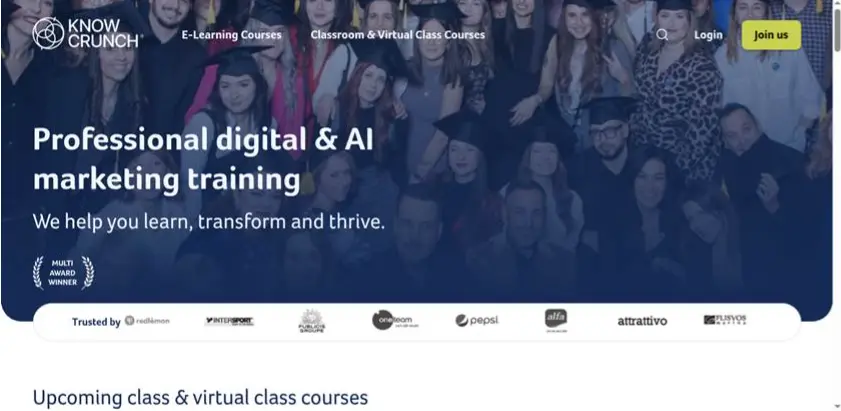
Knowcrunch website
Knowcrunch runs a Masterclass in Digital and AI Marketing spanning 128 to 144 hours, built around specialized tracks in Google Ads, Meta Ads, Canva, and CapCut rather than a single generic curriculum. The program has picked up 32 industry awards, and its instructor network is made up of working C-suite marketers and agency leads rather than career trainers reading from a slide deck.
What sets it apart from most of the list is breadth without dilution. Its online digital marketing courses cover career paths across 14 specializations, so a learner headed toward paid media isn’t stuck sitting through weeks of unrelated content built for someone targeting SEO or content strategy. The tradeoff is that the program leans structured and cohort-based, so it suits someone who wants a defined path more than someone who wants to browse videos at 2 a.m. and skip around.
2. Simplilearn
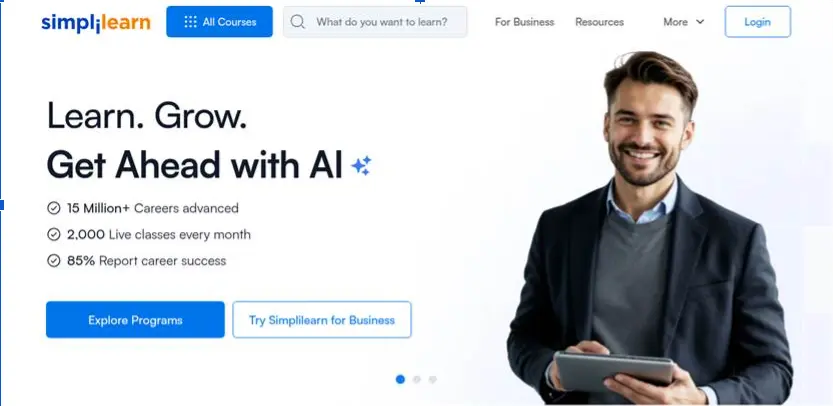
Simplilearn website
Simplilearn is one of the larger paid bootcamp-style providers, and it shows in the catalog size. Its digital marketing track blends self-paced modules with live masterclasses, covering SEO, SEM, social media, analytics, and paid advertising. It’s a reasonable fit for working professionals who need scheduling flexibility more than a tightly curated path, though the sheer volume of content can feel unfocused compared to a specialization-first model.
3. CareerFoundry
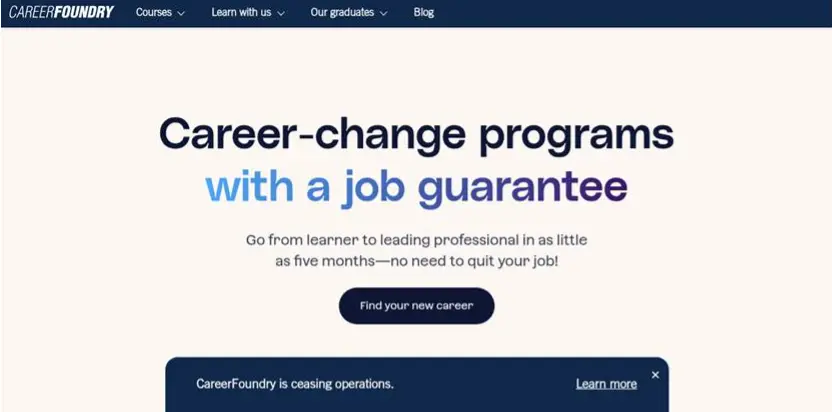
CareerFoundry website
CareerFoundry runs a mentor-driven, self-paced program built around a job guarantee model, and it added generative AI tool training to its curriculum in 2026 to keep pace with how campaigns are actually built now. Content marketing comes up constantly across these programs, and a recent breakdown of content marketing strategies for 2026 shows why campaign strategy skills matter as much as tool fluency. CareerFoundry’s mentor model works well for people who want individual feedback, though it comes at a higher price point than purely self-paced alternatives.
4. Digital Marketing Institute (DMI)
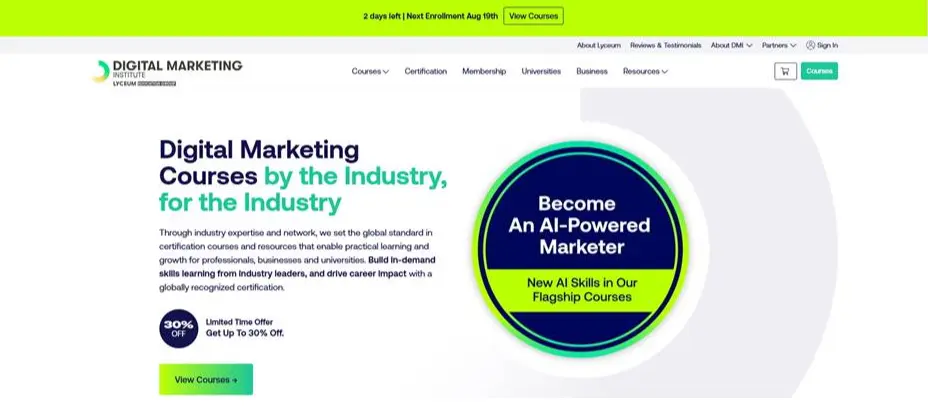
Digital Marketing Institute website
DMI is an internationally accredited certification body, and that accreditation is the whole selling point. Plenty of corporate training programs run on DMI credentials specifically because they’re recognized across markets rather than tied to one platform’s brand. That global recognition matters if you’re trying to understand the core scope of digital marketing careers beyond a single region or employer. What it doesn’t offer is much hands-on project work; it’s a credential-first model, not a portfolio-first one.
5. CXL
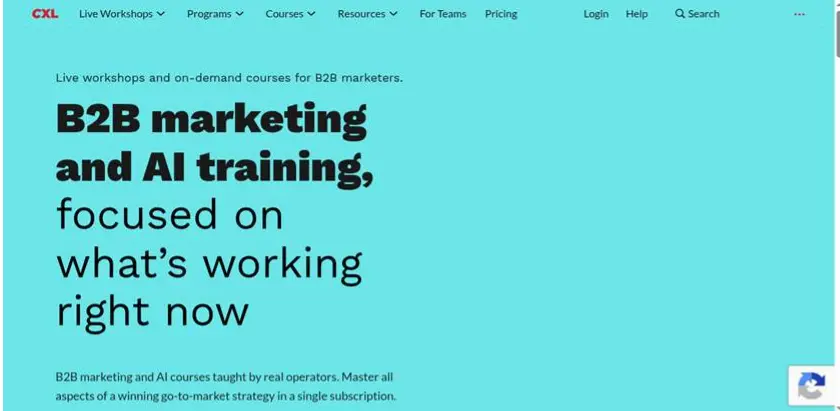
CXL website
CXL is a specialist platform built for conversion optimization, growth marketing, and analytics. It’s genuinely strong content, but it assumes you already have foundational marketing experience. Someone brand new to the field will likely find the material dense and disorienting rather than a good starting point. This one belongs later on a learning path, not at the beginning of it.
6. Digital Vidya
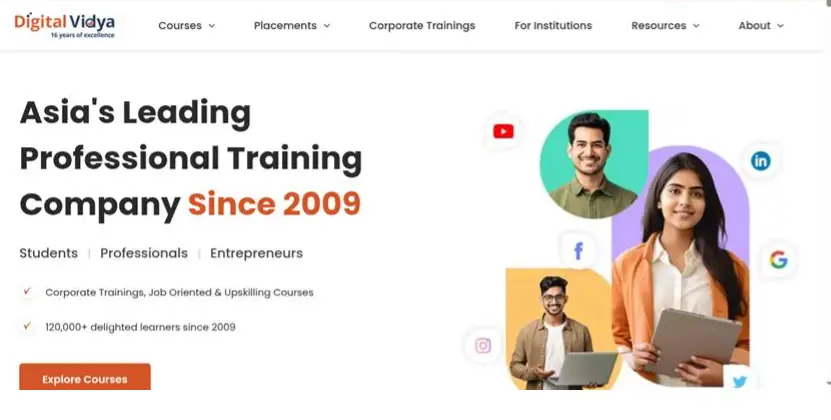
Digital Vidya website
Digital Vidya is an India-based, agency-style training provider offering live classes and placement assistance, and it’s particularly popular with career-switchers across South Asian markets. Its instructors often run active agency work alongside teaching, which keeps the curriculum grounded in current client demands. Its programs also put a strong emphasis on hands-on assignments, with learners working on SEO, paid advertising, social media, email marketing, and analytics projects. The curriculum includes practical experience with widely used marketing tools, as well as case studies and capstone projects that give learners opportunities to apply what they cover in class.
What to Look for When Choosing an Online Digital Marketing Course Provider

A few criteria separate a genuinely useful program from a glorified video playlist. Look at who’s teaching, whether the curriculum reflects current tools such as AI-assisted ad platforms and analytics suites, and whether you’ll build real campaigns rather than just watch someone else build them. The software side matters here too, since developing the software skills employers actually look for can make the training more useful when it’s time to apply for jobs. Flexibility matters as well: self-paced formats suit working professionals, while live cohorts suit people who want structure and accountability.
The stakes for getting this right are rising. The U.S. Bureau of Labor Statistics projects employment of market research analysts to grow 7% from 2024 to 2034, with roughly 87,200 openings projected annually. The AMA’s research on marketer skills gaps points to digital marketing, analytics, and proving ROI as the widest competency gaps employers currently face. A course that doesn’t address those areas directly is training you for a job market that no longer exists.
Choosing the Right Fit
None of these six providers is wrong, exactly, but they’re built for different learners. Someone who wants a specialization-first path with award-recognized instructors and a defined career track will get more out of a program like Knowcrunch’s than out of a broad, catalog-style bootcamp. Someone who already has marketing experience and wants to go deep on conversion and growth work should skip ahead to a specialist platform instead of starting from scratch.
The AMA’s skills data and the UK government’s Skills England Sector Skills Needs Assessment (2026) both point the same direction: employers want people who can prove they’ve built something real, not just people who finished watching a course. Pick the provider whose format matches how you actually learn, and treat the credential as the byproduct rather than the goal.
FAQs
1. What is the best online digital marketing course in 2026?
The best course depends on your goals and experience. Knowcrunch is a strong option for learners seeking a structured, specialization-focused program, while Simplilearn suits professionals who want a broad curriculum with flexible learning options. CareerFoundry is useful for learners who value mentorship, while CXL is better suited to experienced marketers seeking advanced growth and conversion skills.
2. Are online digital marketing courses worth it?
Yes, especially when they include practical projects, current marketing tools, instructor guidance, and portfolio-building opportunities. A course is more valuable when it helps you demonstrate real marketing skills rather than simply providing a certificate.
3. Can beginners take an online digital marketing course?
Yes. Many online digital marketing courses are designed for beginners and cover fundamentals such as SEO, social media marketing, paid advertising, email marketing, content marketing, and analytics. Beginners should prioritize programs with structured learning paths, mentor support, and hands-on assignments.
4. What should I look for in a digital marketing course?
Look for an up-to-date curriculum, experienced instructors, practical projects, industry-relevant tools, mentorship, flexible learning options, and strong reporting or analytics training. If your goal is employment, portfolio-building and career support can be particularly valuable.
5. How long does it take to learn digital marketing online?
The time varies depending on the course and your learning schedule. A structured program may take several weeks or months, while self-paced learning can take longer or shorter depending on how much time you dedicate each week. Building job-ready skills usually requires continued practice beyond completing the course.
6. Do I need a marketing degree to learn digital marketing?
No Digital marketing can be learned without a traditional marketing degree. Online courses can provide practical knowledge in areas such as SEO, advertising, analytics, social media, and content marketing. Building projects and demonstrating measurable results can also help when applying for digital marketing roles.
7. Which digital marketing skills are most important in 2026?
Important skills include SEO, analytics, paid advertising, content strategy, social media marketing, AI-assisted marketing, conversion optimization, and the ability to measure and communicate marketing ROI. Strong analytical and strategic thinking skills are also increasingly valuable.
8. Is certification important for a digital marketing career?
A certification can demonstrate that you have completed structured training, but it should not be the only goal. Employers often value practical experience, portfolio projects, campaign knowledge, analytical ability, and the ability to demonstrate measurable results alongside certifications.
Conclusion
The best online digital marketing course depends on what you want to achieve. Beginners may benefit most from structured, mentor-led programs with hands-on projects, while experienced marketers may prefer specialist platforms focused on areas such as conversion optimization, analytics, or growth marketing.
The strongest programs go beyond certificates. They help learners build practical skills in SEO, paid advertising, social media, analytics, content marketing, AI tools, and campaign strategy. Look for a course that gives you opportunities to work on real projects and create a portfolio you can show employers.
As digital marketing continues to evolve, choosing a course that keeps pace with AI, analytics, and changing employer expectations is increasingly important. Whether you choose Knowcrunch, Simplilearn, CareerFoundry, DMI, CXL, or Digital Vidya, focus on the program that matches your experience, learning style, career goals, and need for practical experience.