
If you’ve typed “Rephrasy review” into Google, you’re probably trying to answer one simple question: does this AI humanizer actually work, and is it worth paying for? This review covers everything you need to decide the AI humanizer and AI detector, the plagiarism checker, writing-style cloning, current pricing, what independent testers have found, and how Rephrasy stacks up against its closest competitors.
We pulled together information from Rephrasy’s own site, its Trustpilot and Google Play listings, and a handful of independent third-party reviews and comparison sites, so you’re not just getting marketing copy repeated back to you.
What Is Rephrasy?
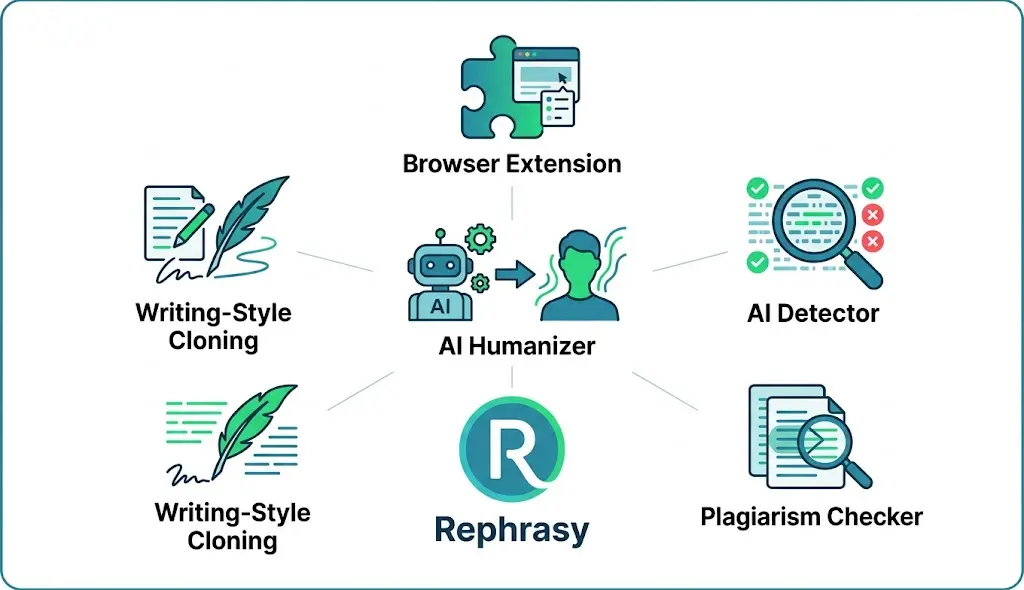
Rephrasy is a credit-based AI humanizer and AI detector aimed at students, content writers, and agencies who need to rewrite AI-generated text so it reads more naturally. It also includes a plagiarism checker, a writing-style cloning feature, a Chrome extension, an API, and mobile apps.
The tool’s interface and feature list are genuinely competitive with the rest of the market. Where things get murkier is on detector bypass performance independent reviewers have published conflicting results, ranging from strong to disappointing, and Rephrasy’s own Trustpilot page currently shows a very small number of reviews. That combination means you should treat any “95% bypass rate” style claim, from Rephrasy or from any competitor, as a marketing number until you’ve verified it yourself. We’ll show you how to do that later in this article.
What does Rephrasy do?
Rephrasy is a web-based platform that takes AI-generated text from ChatGPT, Claude, Gemini, or similar tools and rewrites it so it reads more like something a person typed. Alongside the humanizer, it bundles an AI content detector, a plagiarism checker, and a feature that tries to clone your personal writing style so the output sounds like you rather than like a generic rewrite.
In plain terms: you paste in AI-written text, pick a mode or style, and Rephrasy rewrites the sentence structure, rhythm, and word choices. The stated goal is to reduce the statistical patterns, things like very even sentence length and low “burstiness” that AI detectors are trained to spot.
Who is Rephrasy designed for?
Based on its feature set and marketing, Rephrasy targets four main groups: students who want to smooth out AI-assisted drafts, freelance and in-house content writers producing high volumes of text, SEO teams and marketers who need content that reads naturally, and developers or agencies who want to plug humanization into their own workflow via the API.
What AI models does Rephrasy support?
Rephrasy is designed to work on text generated by any large language model, and its marketing specifically calls out ChatGPT, Claude, Gemini, DeepSeek, and Grok, among others. This matters less than it sounds; a humanizer doesn’t need to “know” which model wrote the text, since it’s rewriting the output rather than analyzing the model itself. The claim is more about compatibility (it handles English and non-English output from any of these tools) than about any special integration.
How Does Rephrasy Work?
AI text humanization
You paste or upload your AI-generated text, choose a humanization mode or intensity level, and the tool rewrites it. Depending on the mode, this can mean anything from light word-swapping to a full restructuring of sentence length and paragraph rhythm.
AI content detection
Rephrasy’s built-in detector scans text and returns an “AI score” , an estimate of how likely the content is to be flagged as machine-generated by other detection tools. This is meant to let you check your work before you submit or publish it, rather than finding out after the fact.
Writing-style cloning
This feature lets you feed in samples of your own writing so the model learns your typical sentence patterns, vocabulary, and tone, and applies that style when it rewrites new text. In theory this produces more personalized, less generic-sounding output than a one-size-fits-all humanizer mode.
Re-humanization
If your first output still gets flagged by a detector, Rephrasy allows you to run the same text through the humanizer again sometimes at a higher intensity rather than starting from scratch.
Plagiarism checking
The plagiarism checker scans your text against existing online content and flags overlapping passages, similar to tools like Turnitin or Copyscape, though on a smaller scale.
It’s worth being clear here: these are descriptions of how the workflow is designed to function, based on Rephrasy’s own product pages. We haven’t independently verified the underlying detection accuracy of every claim, and neither should you take it on faith more on that in the testing section below.
Rephrasy Features
AI Humanizer
The core product. Multiple rewriting intensities let you choose between a light touch (for text that already sounds mostly human) and a heavier rewrite (for content headed into a high-scrutiny academic or institutional setting).
AI Detector
A built-in scanner that estimates the likelihood text will be flagged as AI-generated by third-party detectors. Useful as a first check, but no single detector including this one should be treated as the final word, since detector results famously disagree with each other.
Writing Style Cloning
Trains on samples of your own writing to produce output that more closely matches your natural voice, rather than a generic “humanized” tone that can feel just as templated as raw AI text.
Plagiarism Checker
Scans for duplicate or closely matching content online, which is useful for writers and students who want to confirm originality before submitting work.
Readability Checker
Evaluates sentence complexity and readability scores so you can confirm the humanized text is still easy to follow, not just detector-resistant.
Chrome Extension
Lets you humanize or check text directly inside your browser handy if you’re working in Google Docs, Gmail, or a CMS and don’t want to keep switching tabs.
Rephrasy API
Gives developers and agencies programmatic access to the humanizer and detector, so the tool can be built into a content pipeline, CMS plugin, or internal tool rather than used manually.
Mobile App
Rephrasy publishes an Android app (listed on Google Play as “AI Humanizer Detector Checker”) and is also referenced as available on iOS in some third-party listings. The mobile app matters for this review because it shows up directly in Google’s search results with its own rating and review count, which gives us an independent (if still limited) data point beyond the company’s own marketing.
Rephrasy Pricing
Pricing for AI humanizers changes often as vendors compete on price, so treat the figures below as a snapshot rather than gospel, always check Rephrasy’s live pricing page before buying.
| Plan | Approx. Price | What You Get |
| Quick Pass | ~$10–13 one-time | 24-hour access to the humanizer and detector, plus a limited number of plagiarism check credits |
| Growth | ~$14–15/month | Around 100 monthly credits (roughly 2,000 words per credit) for the detector or humanizer |
| Business | ~$21/month | Roughly double the Growth plan’s credits, aimed at heavier users |
| Professional | ~$34–39/month | Higher credit allowance, plus API access and additional writing styles |
| Lifetime Plan | ~$199 one-time | One-time payment for ongoing access, reported by several third-party reviews |
Pricing last checked via third-party sources in mid-2026; figures vary between reviewers, which is itself a signal that you should confirm current numbers on Rephrasy’s own site before purchasing.
What do you actually get for the price?
You’re paying for a pool of monthly credits, where each credit typically covers a set word count on either the humanizer or detector. Higher tiers add API access, more writing-style presets, and on some plans Turnitin-style reports.
Is Rephrasy good value?
That depends heavily on two things: whether unused credits roll over (several independent reviews report that they do not, meaning unused capacity is lost at the end of the billing cycle), and how reliably the output actually bypasses the detectors you personally care about. A cheap plan that fails half the time isn’t a bargain, it’s a plan you’ll pay for twice.
Does Rephrasy Actually Work?
This is the most important question in this review, and it’s also the one where the answer is genuinely mixed, because independent sources disagree.
Our testing methodology (and why it matters)
If you want to evaluate Rephrasy or any humanizer honestly, here’s a methodology worth following:
- Sample creation: Generate a fresh AI sample from a current model (ChatGPT, Claude, or Gemini), at a fixed word count (500–1,000 words is typical).
- Human-written baseline: Include a genuinely human-written sample of similar length and topic, so you have a control group.
- AI-generated baseline: Run the original AI text through a detector first, to confirm it actually gets flagged (some short or heavily edited AI text won’t).
- Rephrasy output: Run the same AI sample through Rephrasy at a chosen intensity.
- Detector testing: Check the humanized output against two or three independent detectors not just Rephrasy’s own since detectors disagree with each other regularly.
- Readability evaluation: Run both the original and humanized text through a readability score (like Flesch-Kincaid) to confirm meaning and clarity weren’t sacrificed for detector evasion.
What independent reviewers found
We did not run our own paid subscription test for this article, so rather than presenting invented numbers as fact, here’s an honest summary of what’s publicly available:
- Some reviewers report Rephrasy’s humanized output passing most or all of the major detectors they tested against, describing the writing quality as natural and the meaning as well-preserved.
- Other independent reviews report the opposite, that humanized output was still flagged as AI-generated by detectors like GPTZero, and that the tool struggled specifically with longer or academic-style text.
- Rephrasy’s own Trustpilot page shows a small number of reviews at the time of writing, which limits how much confidence you can place in the aggregate rating either way.
The honest takeaway: detector bypass results for Rephrasy like almost every humanizer on the market vary by detector, by text length, by topic, and by which review you read. If detector evasion for a high-stakes submission (like a graded academic paper) is your goal, run your own test on your own text before you rely on it.
Writing quality test
Across the reviews we looked at, a few consistent themes emerge on writing quality:
- Grammar: Generally reported as clean, with few outright errors.
- Readability: Some reviewers found the output natural, others noted awkward phrasing on longer or more technical passages.
- Sentence structure: The tool does vary sentence length and rhythm, which is the mechanism most humanizers use to disrupt detector patterns.
- Vocabulary: Generally not over-the-top or thesaurus-swapped, which is a common complaint about older, simpler paraphrasing tools.
- Meaning preservation: Most reviews report meaning is preserved reasonably well, though heavier rewrite modes carry more risk of subtle meaning drift, so always proofread the final output yourself.
- Naturalness: This is the most disputed category, with reviewer opinions ranging from “reads like a person wrote it” to “still has a slightly mechanical rhythm.”
Does Rephrasy preserve your original meaning?
In most reported tests, yes, at least at a broad level the core argument or information in a passage typically survives the rewrite. But no automated rewriting tool is risk-free for meaning drift, especially on nuanced or technical content, so a manual read-through before publishing or submitting is a good habit regardless of which humanizer you use.
Does Rephrasy really clone your writing style?
The style-cloning feature is one of Rephrasy’s more distinctive claims, and its mechanically plausible fine-tuning or prompting on writing samples to match tone and sentence patterns is a well-understood technique. How well it performs in practice will vary by how much sample text you provide and how distinctive your own writing style already is. Treat it as a helpful starting point rather than a guaranteed match.
Rephrasy AI Detector: How Accurate Is It?
What does the Rephrasy AI score mean?
The AI score is Rephrasy’s own estimate of how likely a piece of text is to be flagged as AI-generated. It’s a useful directional signal low score, less likely to be flagged; high score, more likely but it’s an internal metric, not a universal standard.
How does it compare with other AI detectors?
This is genuinely hard to answer definitively, because independent, apples-to-apples benchmarking across detectors is rare and results shift as detectors update their models. What we can say is that AI detection as a category has a well-documented accuracy problem see the next section.
Why AI detector results can differ
AI detectors, including Rephrasy’s own and third-party tools like GPTZero, Turnitin, Originality.ai, and Copyleaks, don’t all use the same underlying model or training data. That means the same piece of text can get wildly different scores from different tools. Detectors also have known false-positive problems flagging genuinely human-written text as AI-generated, particularly text from non-native English writers or writers with a very plain, direct style. This is a well-documented, widely discussed issue in academic and journalism circles, not a fringe complaint.
The practical implication: don’t treat any single AI score from Rephrasy or a competitor as a verdict. Treat it as one data point.
Rephrasy Reviews: What Are Users Saying?
Trustpilot reviews
At the time of research, Rephrasy’s Trustpilot page had a small number of reviews, including at least one detailed positive review describing the API as fast and reliable for an SEO content workflow. With such a small sample size, though, it’s not yet possible to draw a statistically confident conclusion about overall satisfaction; a handful of reviews can be skewed by who happens to leave feedback.
Google Play reviews
Rephrasy’s Android app, listed as “AI Humanizer Detector Checker,” carries a rating in the mid-3-star range based on the reviews visible at the time of writing, with some users praising the convenience of pasting text on mobile and others reporting technical hiccups. As with any app store listing, read the most recent reviews rather than the aggregate score alone, since app performance can change between updates.
Reddit discussions
Rephrasy comes up periodically in broader Reddit threads about AI humanizers and detector-bypass tools (subreddits like r/ChatGPT, r/artificial, and academic-integrity-adjacent communities discuss this category regularly). The general pattern in these discussions mirrors what we found in written reviews: some commenters report success with humanizer tools broadly, while others are skeptical that any humanizer reliably beats modern detectors, and some raise academic-integrity concerns about using these tools for graded coursework at all. Because specific Rephrasy threads are sparse and can date quickly, it’s worth checking a humanize ai text thread for a broader read, or searching Reddit directly, before relying on any single comment thread.
Rephrasy Pros and Cons
Pros
- Simple, modern interface that most reviewers found easy to navigate
- Bundles multiple tools (humanizer, detector, plagiarism checker) in one subscription
- Writing-style cloning is a genuine differentiator versus basic paraphrasers
- API access available for developers and agencies
- Mobile app for on-the-go use
- Claims support for 50+ languages
- Re-humanization option if the first pass doesn’t satisfy you
Cons
- Pricing structure (credits, tiers, expiring balances) takes some effort to understand
- Independent test results are inconsistent some reviewers report strong detector bypass, others report failures
- No single AI detector result, including Rephrasy’s own, should be treated as definitive
- Small independent review sample on Trustpilot limits confidence in the aggregate rating
- Marketing claims (like specific bypass percentages) need independent verification on your own text
- Heavier rewrite modes carry some risk of subtle meaning or tone drift
Is Rephrasy Safe and Private?
What happens to uploaded content?
Like most SaaS writing tools, Rephrasy processes the text you submit on its servers to generate output. Specifics on retention periods and whether text is used for model training should be confirmed directly in Rephrasy’s privacy policy, since these details can change.
Data privacy and security
Rephrasy’s marketing emphasizes privacy, but “we take privacy seriously” is standard language across this entire product category. Before uploading anything sensitive, read the actual privacy policy rather than relying on marketing copy.
Should you upload confidential documents?
As a general rule with any cloud-based AI writing tool, not just Rephrasy, avoid uploading confidential client work, unpublished research, personally identifiable information, or anything covered by an NDA unless you’ve confirmed the vendor’s data handling terms explicitly permit it.
Privacy considerations for API users
If you’re integrating the API into a product or internal tool, check Rephrasy’s terms of service and privacy documentation for details on data retention, logging, and whether submitted text is used to improve their models. Link directly to Rephrasy’s official privacy page from within your own product documentation so your team always has the current version, not a screenshot that goes stale.
Who Should Use Rephrasy?
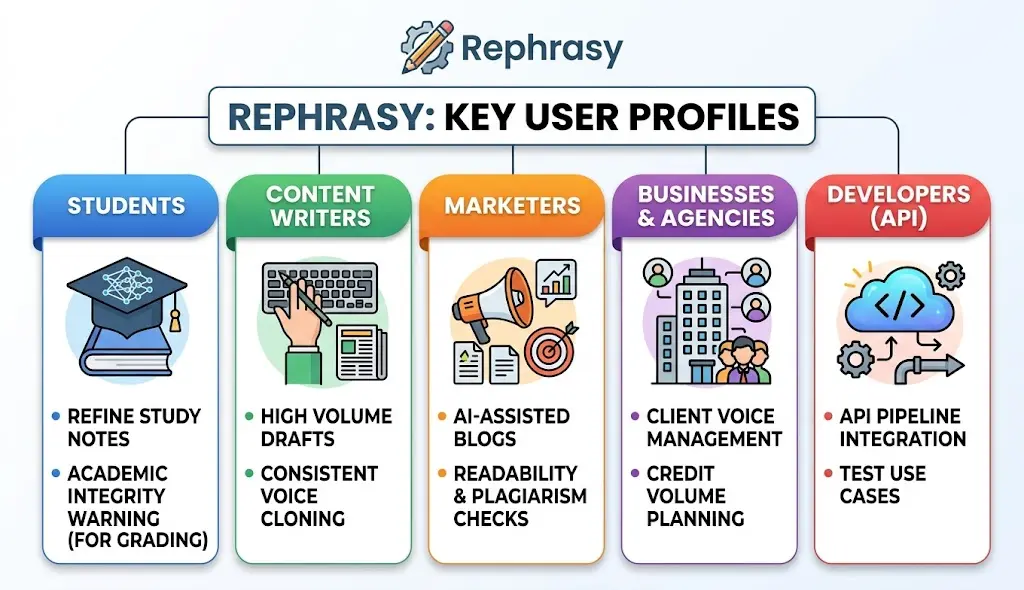
Students
If you’re using AI tools to help draft study notes or early outlines, a humanizer can smooth out mechanical-sounding phrasing. It should not be used to submit AI-generated work as your own for graded assignments; that’s an academic integrity issue independent of whether a detector catches it, and many institutions treat it as a violation regardless of detection outcome.
Content writers
Writers producing high volumes of AI-assisted drafts may find the style-cloning feature genuinely useful for keeping a consistent voice across articles.
Marketers
Teams publishing AI-assisted blog content or ad copy at scale may benefit from the readability and plagiarism checks bundled into one subscription.
Businesses and agencies
Agencies managing multiple client voices could use the style-cloning feature per client, though the credit-based pricing needs to be modeled against real monthly volume first.
Developers using the API
If you’re building humanization into a larger content pipeline, the API is the most relevant feature, test it against your specific use case and detector requirements before committing to a paid tier.
Who Should Avoid Rephrasy?
You’re probably not the right fit for Rephrasy or any humanizer, honestly if you:
- Need guaranteed, editor-quality human review rather than automated rewriting
- Handle highly confidential or regulated information and can’t risk uploading it to a third-party service
- Require specialized enterprise compliance certifications (SOC 2, HIPAA, etc.) that aren’t clearly documented by the vendor
- Need highly predictable, repeatable output for a regulated or safety-critical context
- Need authoritative human editing a humanizer changes patterns, it doesn’t add expert judgment
Rephrasy Alternatives
| Tool | Humanizer | Detector | Style Cloning | API | Plagiarism Check | Best For |
| Rephrasy | Yes | Yes | Yes | Yes | Yes | All-in-one bundle with style cloning |
| Undetectable AI | Yes | Yes | Limited | Yes | No | High-volume agencies, batch processing |
| StealthWriter | Yes | Limited | No | Limited | No | Students, multiple output variants |
| QuillBot | Yes (add-on) | No | No | No | Yes | Users who already pay for QuillBot’s paraphraser/grammar suite |
| WriteHuman | Yes | Yes | No | Limited | No | Users who want a visible diff/change view |
| Phrasly | Yes | Yes | No | Limited | No | Academic essay workflows |
| TwainGPT | Yes | Yes | No | No | No | Casual users comparing multiple humanizers |
Rephrasy vs Undetectable AI
Undetectable AI is generally positioned as stronger for high-volume, API-driven workflows and batch processing. Rephrasy’s edge is the bundled plagiarism checker and style-cloning feature in the same subscription.
Rephrasy vs StealthWriter
StealthWriter is known for returning multiple rewrite variants per pass. Independent reviews on both tools are mixed on detector bypass consistency, so this comparison is worth testing on your own sample text rather than deciding on marketing claims alone.
Rephrasy vs QuillBot
QuillBot is primarily a paraphrasing and grammar tool with a humanizer feature layered on; it’s a good fit if you already use QuillBot’s other writing tools daily. Several independent tests report that QuillBot’s paraphrasing alone (without a dedicated humanizer approach) is less effective at reducing AI-detection scores than purpose-built humanizers, since it tends to swap words rather than restructure sentence-level patterns.
Rephrasy vs WriteHuman
WriteHuman is frequently highlighted for showing users exactly what changed between the original and humanized text, which some writers find reassuring for meaning-preservation checks. Rephrasy doesn’t emphasize a diff view in the same way.
Rephrasy vs Phrasly
Phrasly leans into academic essay workflows, including citation handling. If your primary use case is coursework rather than general content, it’s worth comparing directly against Rephrasy’s academic-oriented plans.
Rephrasy vs TwainGPT
TwainGPT is a smaller, more casual entrant in this space. If you’re just testing whether humanizers work for your use case before committing a budget, it’s a reasonable low-stakes comparison point.
Rephrasy vs AI Paraphrasers: What’s the Difference?
1. Humanizer vs paraphraser
A paraphraser mostly swaps words for synonyms and shuffles sentence order; it changes the surface text but often leaves the underlying statistical fingerprint (like consistent sentence length and low variation) largely intact, which is exactly what modern AI detectors are trained to catch. A true humanizer, by contrast, restructures sentence rhythm, varies length and complexity, and tries to disrupt those deeper patterns rather than just the vocabulary.
2. Humanizer vs AI detector
These solve opposite problems. A detector estimates whether text was AI-generated; a humanizer tries to rewrite text so it won’t be flagged as such. Rephrasy like several competitors bundles both, which is convenient but also means you’re trusting the same company’s detector to grade its own humanizer’s work. Cross-checking with an independent, third-party detector is a smart extra step.
3. Humanizer vs grammar editor
A grammar editor (like Grammarly) fixes spelling, punctuation, and clarity issues without trying to disguise the text’s origin. A humanizer’s goal is different: pattern disruption for detection purposes, not correctness. You may well want both a humanizer pass to vary sentence patterns, and a grammar pass afterward to catch anything that reads awkwardly.
How to Use Rephrasy
- Open Rephrasy – go to the official site and create an account.
- Add your text – paste in the AI-generated content you want to rewrite, or upload a document.
- Select your preferred style – choose a humanization mode or intensity, and apply a cloned writing style if you’ve set one up.
- Humanize the content – run the rewrite and review the output.
- Review the output – read through for meaning drift, tone shifts, or awkward phrasing.
- Check readability and originality – run the built-in readability and plagiarism checks before publishing.
- Edit the final version manually – treat the humanized draft as a strong first pass, not a finished product; a human editing pass is still worth doing.
Is Rephrasy Legit?
Yes, in the sense that it’s a real, operating company with an official website, a published pricing page, an active mobile app on Google Play, and a Trustpilot presence — this isn’t a fly-by-night scam operation.
Where you should stay skeptical is on performance claims specifically. Independent third-party test results on detector bypass rates are inconsistent across reviewers, Rephrasy’s own review volume on Trustpilot is currently small, and pricing terms (like whether credits roll over) vary depending on which source you check. None of that means the product doesn’t work — it means you should verify performance and pricing against your own use case before committing to an annual plan or the lifetime deal.
Is Rephrasy Worth It?
Worth it for students?
Only for legitimate uses like smoothing early drafts or study notes — not for evading academic-integrity checks on graded work, which carries real institutional risk regardless of whether a detector flags it.
Worth it for writers?
Potentially, if the style-cloning feature genuinely matches your voice and the credit allowance fits your monthly output. Test the free or low-cost tier first before committing to a higher plan.
Worth it for marketers?
Reasonably good value if you’re already publishing AI-assisted content at volume and want readability and plagiarism checks bundled in, but weigh it against dedicated SEO content tools you may already use.
Worth it for businesses?
Depending on scale the credit-based pricing rewards consistent, predictable usage more than spiky, occasional use.
Worth it for developers?
The API is the most compelling reason to choose Rephrasy over a manual-only competitor, assuming your own testing confirms acceptable detector bypass and output quality for your specific content type.
Final recommendation: There’s no universal verdict here. Rephrasy is a legitimate, reasonably full-featured tool worth trialing on a low-cost plan first, with your own text and your own detector checks, before you commit to a bigger subscription.
Frequently Asked Questions About Rephrasy
1. Is Rephrasy free to use?
Rephrasy offers a limited free or trial-level way to test the tool, but most meaningful usage requires a paid plan to check the current pricing page for exact free-tier limits.
2. Does Rephrasy work on Turnitin?
Some plans reference Turnitin-style reporting, but as with any detector, results are inconsistent across reviewers and can change as Turnitin updates its own detection model. Test on your own sample before relying on it for high-stakes submissions.
3. Is using an AI humanizer considered cheating?
For academic work, using a humanizer to submit AI-generated content as your own original work is generally considered an academic integrity violation by most institutions, independent of whether any detector actually flags it.
4. How accurate is Rephrasy’s AI detector?
Like all AI detectors, it’s directionally useful but not infallible false positives and false negatives are a known, documented issue across the entire detector category, not unique to Rephrasy.
5. Can I cancel my Rephrasy subscription anytime?
Most subscription-based tools in this category allow cancellation, typically taking effect at the end of the current billing cycle to confirm the specific terms on Rephrasy’s billing page before subscribing.
6. Does Rephrasy support languages other than English?
Yes, Rephrasy’s marketing states support for 50+ languages, though output quality consistency across less common languages hasn’t been independently benchmarked in the reviews we found.
Conclusion
Rephrasy is a legitimate, full-featured entrant in the crowded AI humanizer market, bundling a humanizer, detector, plagiarism checker, style-cloning tool, API, and mobile app into one product. The interface and feature breadth compare well against competitors.
The honest caveat, and the reason this Rephrasy review can’t hand out an unqualified “yes, buy it”: independent performance data on detector bypass is mixed, review volume is still small, and pricing details vary by source. If you’re considering it, start with the lowest-cost plan, run your own test on your own text against the detectors that actually matter for your use case, and make your decision from there rather than from any single review including this one.