
If you own a content agency or publish work from freelancers or manage a team of writers you have probably been asked a question that makes you uncomfortable: is this piece of writing actually written by a human? This question is the reason why Originality AI was created. Now a lot of publishers use Originality AI to check if a piece of writing is written by a human or not. They do this as a part of their editorial checklist.
This review of Originality AI will tell you what Originality AI does, how much it costs this year and how well it works with types of artificial intelligence. We will also tell you where Originality AI is not so good. Then we will talk about tools that are similar to Originality AI so you can decide if Originality AI is right, for you and your team of writers.
Is Originality AI Worth It?
Originality AI is one of the reliable AI detectors available for content teams but it is not perfect and it is not affordable for casual users. It has built its reputation through detecting plagiarism and scanning for AI content in one single check, which helps agencies save real time.
Testing done independently in 2025. 2026 Has shown that Originality AIs real-world detection accuracy is much lower than what the company says. Common numbers range from the 70s to high 80s percent depending on the test data instead of the “99%+” that the company claims. This difference is normal across the industry not just, for Originality AI but it is important when you are deciding how much to trust a single score.
Who Should Buy It
Content agencies, publishers and SEO teams that get a lot of freelance work benefit the most from this. If you need a tool that looks for AI-written content and plagiarism all at once, Originality AIs combined process helps save a lot of time for editors.
Teams that need to keep track of who scanned what and when also get a lot from the team management tools. It is made for companies that need to prove they did their job properly, not for someone who is curious about a piece of writing.
Who Should Skip It
Students on a budget should look elsewhere first. There’s no ongoing free plan, only a small batch of signup credits, and tools like GPTZero offer a generous free tier that covers most academic use cases.
Casual bloggers running the occasional scan may also find the credit system more than they need. If you’re scanning a handful of articles a month, a free detector will usually do the job just as well.
What Is Originality AI?
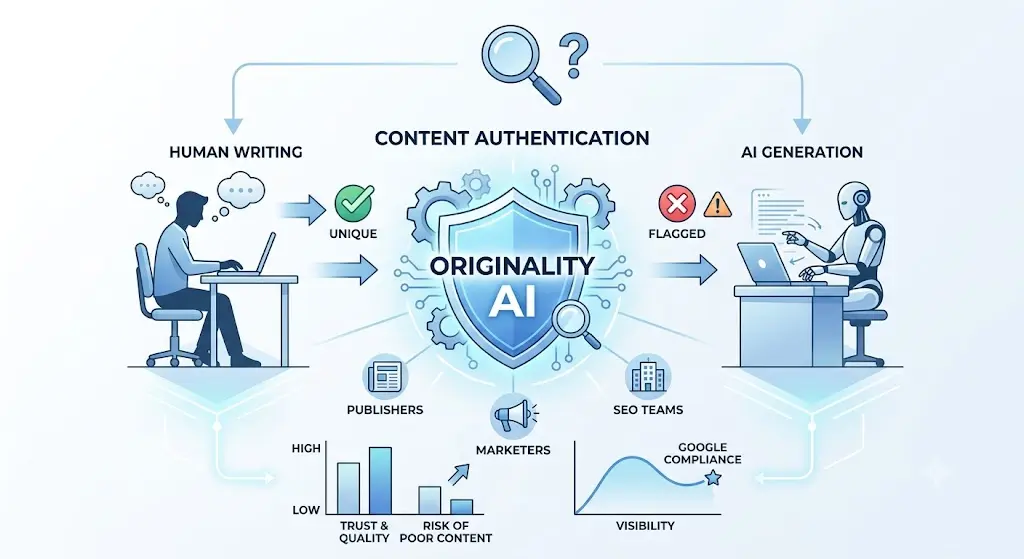
Originality AI is a website that checks if a piece of writing is really written by a person or if it is made by a computer program. This tool is mainly for people who publish things companies that help with search engines and teams that make content for marketing. They need to know if the writing they get from freelancers is actually done by a being, not just created by something like ChatGPT and then slightly changed.
The people behind Originality AI say their tool is important for making sure the things we read are honest and true now that computers can write things that seem like they were written by people. As computers get better at writing, the people who publish things need a way to make sure they are not printing stuff that’s not good quality just because it was easy to make. This helps them keep their standards high and avoid getting in trouble with Google for putting out content.
How It Works
At a technical level, Originality AI analyzes patterns in word choice, sentence structure, and statistical predictability that tend to differ between human and machine-generated writing. Large language models tend to choose more “expected” next words based on probability, while human writing has more natural variation, tangents, and imperfection.
The tool assigns a percentage score representing how likely the content is to be AI-generated, alongside a separate plagiarism report that checks the text against indexed web content. In plain English: it’s trying to spot the statistical fingerprints that most humans leave behind but AI models tend to smooth over.
Who Uses It
The main people who use this thing are companies that make content and have to manage a lot of freelance writers. There are also publishers who need to check the quality of what they’re publishing. Some big companies use it too for their marketing teams. The main people who use this thing are companies that make content and have to manage a lot of freelance writers. There are also publishers who need to check the quality of what they’re publishing. Some big companies use it too as an AI market analysis tool for their marketing teams. Now even the people in charge of hiring like the HR department use it to check the letters and other stuff that people send in when they are applying for a job.. Students do not use it that much because it costs too much money for them. The core user base is made up of content agencies and these other groups, like publishers and, in-house marketing teams and HR departments who all use it for their work.
Core Features
Originality AI bundles several tools into one platform: AI content detection, a plagiarism checker, a fact-checking aid, a readability score, a Chrome extension for scanning content directly on the web, API access for developers, and team management dashboards for agencies overseeing multiple writers.
Originality AI Pricing Explained
Originality AI runs on a credit system rather than a flat unlimited-use subscription. One credit typically covers 100 words for an AI-only scan, while a combined AI-plus-plagiarism scan uses more credits per 100 words. Deep Scan and Fact Checker features consume credits separately, on top of standard checks.
1. Pay-As-You-Go Credits
For occasional users, Originality AI offers a one-time purchase of $30 for 3,000 credits, with no monthly commitment. This suits solo bloggers or freelancers who need to run scans irregularly rather than every day.
2. Subscription Plans
The standard monthly plan starts around $14.95 per month (slightly less if billed annually) and includes roughly 2,000 credits per month, enough to scan around 200,000 words. This is the plan most individual writers and small in-house teams choose.
3. Enterprise Pricing
The Enterprise tier runs around $179 per month and is built for agencies and larger teams. It includes a bigger credit allowance, multiple team seats, extended reporting, and full API access features that matter far more once you’re managing several writers or building AI detection into your own software stack.
4. Is It Worth the Cost?
For a solo blogger scanning a few posts a month, Originality AI is probably more than you need; a free tool will cover the basics. For an agency scanning dozens of freelance articles weekly, the combined AI-and-plagiarism workflow can genuinely save editorial hours, which is where the subscription starts to pay for itself.
One real limitation worth flagging: there’s no ongoing free plan. New users get a small batch of free signup credits, but once those run out, every scan costs money, a meaningful difference from competitors like GPTZero, which offers a recurring monthly free tier.
Hands-On Originality AI Review
1. Testing Methodology
A fair review of any AI detector has to test it against several kinds of content: fully human-written text, raw output from different AI models, mixed human-AI drafts, and AI text that’s been run through a “humanizer” tool to disguise its origin. No single test tells the whole story, which is why detector reviews across the industry increasingly test across model families rather than just ChatGPT.
2. Human Content Tests
Originality AI generally performs well on clearly human-written content, including formal, academic-style prose. Like every detector on the market, it still produces occasional false positives on human writing, particularly with non-native English speakers and heavily-edited drafts that read as unusually polished.
3. ChatGPT Tests
Detection accuracy against raw, unedited ChatGPT output tends to be Originality AI’s strongest category, which matches the industry pattern most detectors were trained heavily on GPT-family outputs since that’s historically been the most widely used AI writing tool.
4. Claude Tests
Detection of Claude-generated text has been reported as a comparative weak spot in independent 2026 testing. This is a common pattern across detectors generally, since each detector’s training data skews toward whichever models were most popular when it was built, and newer or less common model outputs are harder to fingerprint reliably.
5. Gemini Tests
Gemini detection performance sits closer to the ChatGPT results than the Claude results in most published comparisons, though results vary by test set and prompt style.
6. Grok Tests
Grok-generated content is a newer category for most detectors, including Originality AI, and published testing on it remains thinner than for the more established models. Treat any single detector’s Grok results as directional rather than definitive for now.
7. DeepSeek Tests
The same caveat applies to DeepSeek: it’s a newer entrant, and detector training data hasn’t caught up with older, more established models yet. Expect accuracy here to keep shifting as vendors update their models.
8. Mixed AI-Human Content Tests
This is where every detector on the market, Originality AI included, struggles most. A document that’s 30% AI-generated and 70% human-edited doesn’t produce a clean binary answer scores tend to land in an ambiguous middle range that requires human judgment to interpret.
9. Humanized AI Tests
AI text run through paraphrasing or “humanizer” tools is the hardest category for any detector. Originality AI has reportedly performed better than the industry average on paraphrased content in some academic benchmarking, but no detector on the market reliably catches heavily humanized AI writing every time.
Originality AI Features Reviewed
AI Detection
The core feature, and generally the most reliable part of the platform. It returns a percentage likelihood score alongside a confidence indicator, rather than a flat yes/no verdict which is the right approach, since AI detection is inherently probabilistic, not a certainty.
Plagiarism Detection
This is arguably Originality AI’s real differentiator. Running AI detection and plagiarism checking in a single scan, on the same piece of content, is a genuine time-saver for agencies that would otherwise need two separate tools.
Fact Checker
A newer addition that flags claims in a piece of content that may need verification. It’s a useful starting point for editors, though it shouldn’t replace an actual editorial fact-check process for anything published under your brand’s name.
Readability
A standard readability score, similar to what you’d find in tools like Hemingway or Yoast. It’s a nice-to-have rather than a core reason to buy the tool.
Chrome Extension
Lets you scan content directly from a webpage or Google Doc without copying and pasting into the dashboard. Useful for editors doing quick spot checks throughout the day.
API
API access is included on paid plans and uses the same credit pool as manual scans. It’s functional for moderate use, but reviewers have generally rated it as less mature than Copyleaks’ enterprise-grade API, which was built from the ground up for large-scale integration.
Team Management
Let agencies see which team member ran which scan and when. For agencies that need to show clients due diligence around AI content policies, this audit trail is genuinely useful.
Scan History
All past scans are logged and searchable, which matters for publishers managing ongoing disputes with freelancers over AI-generated submissions.
Detection Accuracy Analysis
False Positives
Every AI detector, Originality AI included, occasionally flags genuinely human-written content as AI-generated. Independent testing has put its real-world false positive rate somewhere around one in twenty pieces of human writing, a rate broadly comparable to other top-tier detectors, but not zero.
Non-native English writers, students following formulaic academic structures, and heavily-edited drafts are the groups most likely to trigger a false positive. If you’re using detection scores to make consequential decisions firing a freelancer, failing a student that risk should always be weighed against other evidence.
False Negatives
The flip side is AI content that slips through undetected, especially after paraphrasing or “humanizing.” Independent academic benchmarking (including the RAID study referenced across several 2026 detector reviews) has shown Originality AI performing better than the industry average on paraphrased AI content, though still far from catching everything.
Confidence Scores
Originality AI presents results with a confidence indicator rather than a flat percentage alone, which is a more honest way to communicate an inherently uncertain measurement. Treat a 60% AI score very differently from a 98% score the first deserves human review, not an automatic rejection.
Limitations
No AI detector, including Originality AI, should be treated as a lawyer’s-grade verdict. Detectors are statistical tools that estimate likelihood based on patterns, not tools that can prove authorship with certainty. Academic and journalistic best practice is to combine a detection score with edit-history evidence, writing samples, and direct conversation with the writer before making a final call.
Pros and Cons
Pros:
- Combines AI detection and plagiarism checking in one scan, saving agencies time
- Confidence-scored results rather than a flat yes/no verdict
- Solid team management and audit trail features for agencies
- Performs competitively against strong industry benchmarks on paraphrased AI content
- Pay-as-you-go option for occasional users with no monthly commitment
Cons:
- No ongoing free tier only limited signup credits
- Claude detection and creative-writing detection are comparative weak spots
- Real-world accuracy trails the vendor’s own marketing claims, a pattern common industry-wide
- API access is less mature than dedicated enterprise competitors like Copyleaks
- Credit system can get expensive at high scanning volume
Originality AI vs Competitors
vs GPTZero
GPTZero is the stronger choice for students and academic use, largely because of its generous free tier around 10,000 words a month at no cost and its sentence-level highlighting, which shows exactly which parts of a document triggered the AI flag. Originality AI leans more toward publishers and agencies that need plagiarism checking bundled in, which GPTZero doesn’t offer to the same degree.
vs Copyleaks
Copyleaks is generally considered the stronger option for enterprise and multilingual use cases, with a more developed API and LMS/CMS integration options. Originality AI tends to be the more budget-friendly, simpler-to-implement option for teams that just need detection and plagiarism checking without deep enterprise integration.
vs Winston AI
Winston AI differentiates itself with OCR for scanning handwritten documents and deepfake detection, along with reportedly lower false positive rates on pure human text. Originality AI’s edge is the combined AI-plus-plagiarism workflow, which Winston AI doesn’t replicate as tightly.
vs Turnitin
Turnitin remains the dominant tool in formal education because of how deeply it’s integrated into university systems, and its team has been notably transparent about deliberately allowing some AI content through to keep false positives low. Originality AI isn’t built for institutional academic workflows in the same way it’s aimed squarely at content publishing, not classroom submissions.
vs ZeroGPT
ZeroGPT’s main draw is that it’s free and requires no account, but independent testing has repeatedly found its real-world accuracy well below its advertised numbers, along with a notably high false positive rate. Originality AI costs money but is generally considered more reliable for professional use where the stakes of a wrong call are higher.
vs Scribbr
Scribbr is better known as an academic writing resource that also offers AI detection, and it’s frequently cited as an independent benchmarking source in detector comparison studies. Originality AI is a dedicated commercial detection platform built for ongoing professional use rather than a single-check academic tool.
Best Use Cases
1. SEO Agencies
Agencies managing multiple freelance writers use Originality AI to verify submissions before publishing, protecting themselves from Google’s guidance against low-quality, mass-produced AI content that hasn’t been meaningfully edited.
2. Publishers
Publishers accepting guest posts or freelance contributions use it as a gatekeeping step in the editorial process, often alongside a manual review rather than as the sole deciding factor.
3. Freelancers
Some freelance writers run their own drafts through Originality AI before submission, to preempt disputes with clients who scan incoming work and to catch accidental over-reliance on AI drafting tools.
4. Students
Students are generally better served by GPTZero’s free tier or their institution’s required tool (often Turnitin), since Originality AI’s pricing isn’t built around casual, low-volume academic use.
5. Marketing Teams
In-house marketing teams use it to maintain brand voice consistency and confirm that outsourced content meets editorial standards before it goes live under the company’s name.
6. Enterprise Organizations
Larger organizations, including some HR departments, use the Enterprise plan’s API and audit trail to build detection into internal review workflows at scale.
Real User Reviews
1. Reddit Opinions
Discussion threads on r/SEO and r/content_marketing on Reddit tend to reflect a split opinion: many agency owners find Originality AI’s combined plagiarism-and-AI scan genuinely useful for freelancer quality control, while a recurring complaint is that its detection scores can shift noticeably between scans of the same document, which makes some users hesitant to treat any single score as final.
2. Trustpilot Summary
Third-party review platforms generally show Originality AI with solidly positive but not universally glowing ratings reviewers frequently praise the plagiarism-checking speed while criticizing the lack of a free plan and occasional inconsistency in AI scores.
3. Positive Feedback
The most consistent praise centers on the combined scan workflow, the team management dashboard for agencies, and the straightforward setup with no complicated onboarding process.
4. Common Complaints
The most common criticisms are the absence of an ongoing free tier, weaker performance detecting Claude-generated and creative writing, and occasional score volatility between repeated scans of the same text.
Best Originality AI Alternatives
1. Free AI Detectors
GPTZero’s free tier (around 10,000 words per month) is the strongest free option for casual and academic use. ZeroGPT offers unlimited free scans but comes with a notably higher false positive rate, so treat its results as directional rather than authoritative.
2. Premium AI Detectors
For academic institutions: Turnitin or GPTZero, though it’s worth comparing more options in a dedicated best ai checker for teachers roundup before settling on one. For publishers and agencies: Originality AI or Copyleaks. For budget-conscious casual users: GPTZero’s free tier or ZeroGPT with appropriate skepticism about its accuracy. Another option worth adding to your shortlist is Phrasly, whose AI detector gives you a quick read on which sentences sound too machine written, which is handy when you want a second opinion before treating any single score as final
3. Best AI Detector by Use Case
For academic institutions: Turnitin or GPTZero. For publishers and agencies: Originality AI or Copyleaks. For budget-conscious casual users: GPTZero’s free tier or ZeroGPT with appropriate skepticism about its accuracy.
Expert Tips for Better AI Detection
1. Reduce False Positives
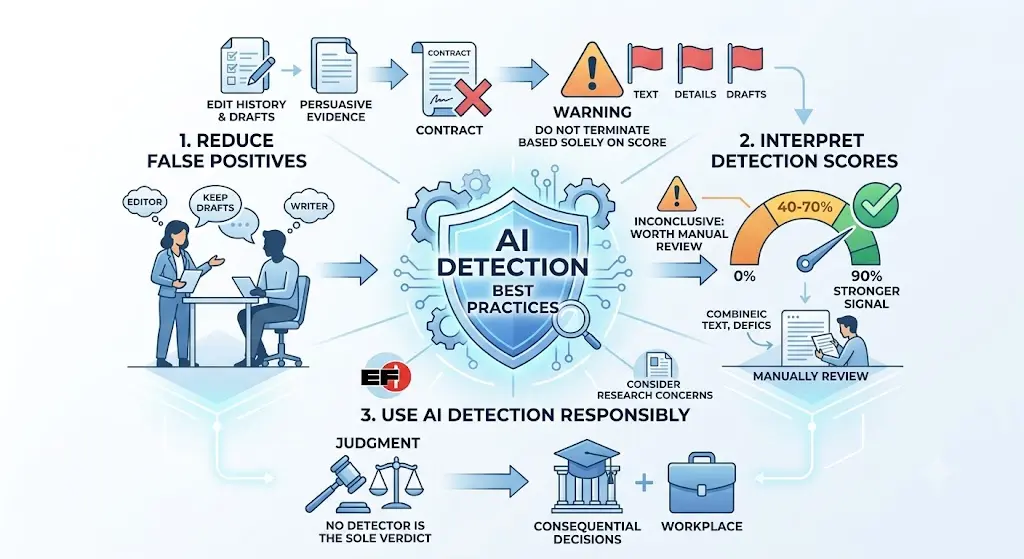
Encourage writers to keep drafts and version history, since edit-history evidence is far more persuasive than a detection score alone when a false positive occurs. Avoid making irreversible decisions like terminating a freelance contract based solely on a single scan result.
2. Interpret Detection Scores
Treat scores in the 40–70% range as inconclusive and worth a manual review, not automatic proof either way. A score above roughly 90% combined with other red flags (generic phrasing, lack of specific detail, no draft history) is a much stronger signal than the number alone.
3. Use AI Detection Responsibly
No detector, Originality AI included, should be the sole basis for a consequential decision about someone’s work or academic standing. The Electronic Frontier Foundation and multiple education researchers have raised concerns about over-reliance on AI detection tools given their documented false positive rates, a caution worth taking seriously before treating any score as a verdict.
Frequently Asked Questions
1. Is Originality AI accurate?
It performs competitively against other commercial detectors, but independent testing consistently shows real-world accuracy below the vendor’s own marketing claims, a pattern true of the entire AI detection industry, not just this tool.
2. Can Originality AI detect Claude-written content?
Detection of Claude-generated text has been reported as weaker than its detection of GPT-family output in independent testing, though it can still flag some Claude-written content.
3. Does Originality AI have a free trial?
There’s no ongoing free plan. New accounts get a small batch of free signup credits, after which every scan draws from a paid credit balance.
4. Is Originality AI worth it for bloggers?
For solo bloggers running occasional scans, a free detector is usually sufficient. Originality AI makes more financial sense once you’re managing multiple writers or need plagiarism checking bundled with AI detection.
5. Can Originality AI be wrong?
Yes. Like every AI detector, it produces both false positives (flagging human writing as AI) and false negatives (missing AI writing, especially after paraphrasing). Treat scores as one input among several, not a final verdict.
6. How much does Originality AI cost?
Pricing starts around $14.95/month for roughly 2,000 credits, with a $30 pay-as-you-go option for 3,000 one-time credits and an Enterprise plan around $179/month for agencies needing team seats and API access.
7. Does Originality AI detect ChatGPT-written content?
Yes, detection of raw ChatGPT output is generally its strongest category, consistent with most detectors on the market.
8. Can Originality AI detect humanized AI text?
It performs above the industry average on paraphrased AI content in some independent academic testing, but no detector reliably catches all humanized AI writing.
9. Is Originality AI better than Turnitin?
They’re built for different purposes. Turnitin is the standard for academic institutions; Originality AI is built for publishers and content agencies and isn’t typically used in formal classroom settings.
10. What is Originality AI mainly used for?
Verifying that freelance or outsourced content is human-written and free of plagiarism before it’s published, primarily by SEO agencies, publishers, and marketing teams.
Conclusion
Originality AI earns its place as one of the more reliable, well-rounded options for content teams that need AI detection and plagiarism checking in a single workflow. It isn’t the cheapest tool on the market, and its accuracy like every detector falls short of the near-perfect numbers in its own marketing.
If you’re an agency or publisher managing freelance content at scale, the combined scan and team management features likely justify the cost. If you’re a student or occasional user, start with a free tool first, and only consider Originality AI once your scanning needs outgrow what free options can handle.
Whichever detector you choose, treat the score as a starting point for human judgment, not a final verdict that’s true of Originality AI, and it’s true of every AI detection tool available in this year.