
If you have typed “Java Full Stack Developer salary in India” into Google, you are probably standing at one of two crossroads. Either you are deciding whether this career is worth the effort, or you already work in the field and want to know if you are being paid fairly. Both are good reasons to read on.
The honest answer is that there is no single number that captures the Java Full Stack Developer salary in India. A fresher in Pune and a senior architect in Bengaluru are technically doing “the same job” on paper, but their pay packets can differ by ten times or more. What actually decides your number is a mix of experience, city, company type, and the specific skills you bring to the table. This guide walks through all of it, with realistic figures and practical advice you can act on.
Java Full Stack Developer Salary at a Glance
Before we break things down by experience and city, here is the big picture.
Average Salary
Public salary data from platforms like Glassdoor and AmbitionBox generally puts the average Java Full Stack Developer salary in India somewhere around ₹5.5 LPA to ₹6 LPA when you look across all experience levels combined. That number can feel misleading though, because it blends fresh graduates with developers who have a decade of experience.
Salary Range
A more useful way to think about it is a range. Across the market, Java Full Stack Developers in India typically earn anywhere from ₹3 LPA at the very entry level to ₹25 LPA or more once they reach senior and architect level roles at strong companies.
Highest Salary
At the top end, developers with deep expertise in microservices, cloud platforms, and system design working at product companies or Global Capability Centres (GCCs) of multinational firms can cross ₹30 to ₹40 LPA. These are not the norm, but they show what is possible with the right skill mix and company.
Entry Level Salary
Freshers with a solid grip on Java, Spring Boot basics, and one frontend framework can expect somewhere between ₹3.5 LPA and ₹6 LPA, depending on the hiring company and how strong their project portfolio looks.
Senior Level Salary
Once you cross the 6 to 8 year mark with strong system design and cloud skills, ₹15 LPA to ₹25 LPA becomes a realistic target, and this is where negotiation skill starts to matter as much as technical skill.
Who Is a Java Full Stack Developer?
A Java Full Stack Developer is someone who can build both sides of a web application: the part users see (frontend) and the part that runs behind the scenes (backend), with Java powering the backend logic.
Roles and Responsibilities
On a typical day, a Java Full Stack Developer might design REST APIs in Spring Boot in the morning, fix a React component bug after lunch, and review a database query performance issue before the day ends. The role demands comfort switching between layers of an application rather than deep specialization in just one.
Core Technologies Used
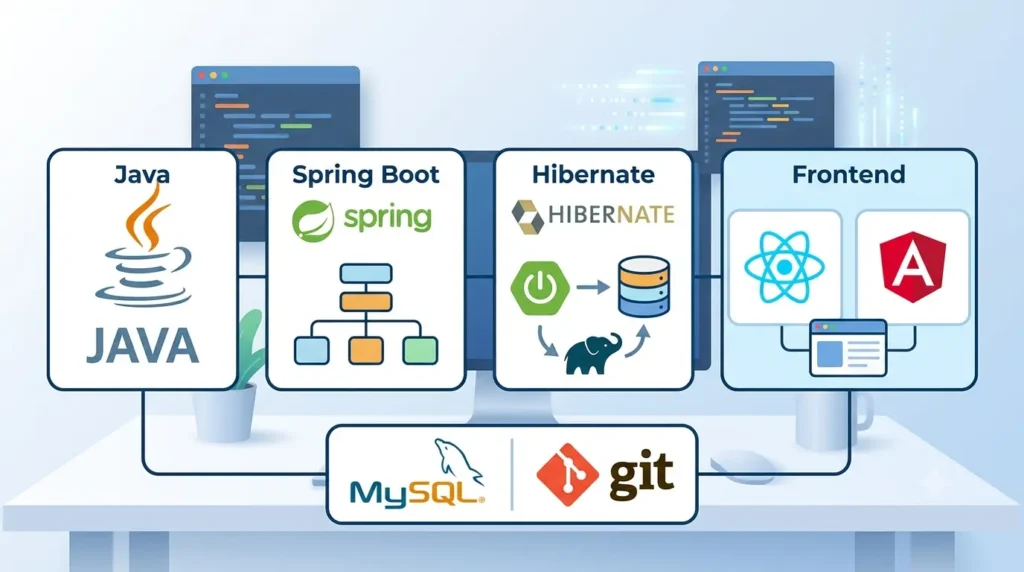
The common toolkit includes Java as the core language, Spring Boot for backend services, Hibernate for database interaction, and either React or Angular on the frontend. SQL databases like MySQL, along with Git for version control, round out the basics that almost every job description asks for.
Industries Hiring Java Full Stack Developers
Banking, insurance, ecommerce, healthcare technology, and IT services companies are the biggest employers of Java talent in India. Java’s reputation for stability and security is exactly why banks and large enterprises still lean on it heavily, even as newer languages compete for attention.
Java Full Stack Developer Salary by Experience
Experience remains the single biggest lever for salary growth in this field. Here is how the numbers typically shape up.
Freshers (0 to 1 Year)
Fresh graduates usually start between ₹3 LPA and ₹6 LPA. Trainees at service based companies often begin closer to the lower end, while candidates who arrive with a couple of deployed personal projects can push toward the higher end of that band.
Early Career (1 to 3 Years)
With a year or two of real project experience, salaries generally move to ₹5 LPA to ₹9 LPA. This is the stage where developers start specializing a bit, whether that means going deeper into Spring Boot or becoming the person the team turns to for frontend issues.
Mid Level (3 to 5 Years)
Mid level developers with 3 to 5 years of experience typically land between ₹9 LPA and ₹15 LPA. At this point, employers expect you to own a feature end to end without much hand holding.
Senior (5 to 8 Years)
Senior developers with 5 to 8 years of experience can expect ₹14 LPA to ₹22 LPA, particularly if they have exposure to microservices, cloud deployment, or team mentoring responsibilities.
Lead Developer (8 to 12 Years)
Leads managing small teams and owning architecture decisions for a module often earn ₹20 LPA to ₹30 LPA, especially at product companies or GCCs.
Architect (12+ Years)
Solution architects and principal engineers with over 12 years of experience frequently cross ₹30 LPA, and at large MNCs or global product companies this can go well beyond ₹40 LPA.
Java Full Stack Developer Salary by City
Where you work matters almost as much as how long you have worked. Metro cities with a dense concentration of tech companies tend to pay noticeably more, though the cost of living there is also higher.
Bengaluru
Often called India’s tech capital, Bengaluru consistently pays among the highest salaries for Java Full Stack roles, thanks to the sheer number of product companies and GCCs based there.
Hyderabad
Hyderabad has grown into a strong second hub, with many global companies setting up development centers that offer salaries close to Bengaluru’s levels.
Pune
Pune offers a good balance of decent pay and lower living costs, making it attractive for developers who want metro level opportunities without metro level rent.
Chennai
Chennai’s IT services heavy market means salaries here tend to sit a notch below Bengaluru and Hyderabad, though the city has a growing number of product startups too.
Mumbai
As India’s financial capital, Mumbai offers strong salaries for developers working in fintech and enterprise software, though the cost of living can eat into that advantage.
Noida
Noida has a healthy mix of service companies and startups, with salaries generally comparable to or slightly below Pune.
Gurugram
Gurugram, home to many corporate headquarters and GCCs, often rivals Bengaluru in pay for experienced developers.
Delhi NCR
Taken together, the Delhi NCR region (Delhi, Noida, and Gurugram) offers a wide salary spread depending on which specific companies are hiring.
Salary by Company Type
The kind of company you join can shift your salary by a wide margin, even at the same experience level.
Service Based Companies
Companies like TCS, Infosys, Wipro, and Cognizant hire in large numbers and offer stable but relatively modest starting salaries. Growth tends to be steady rather than explosive.
Product Based Companies
Product companies pay more for the same experience level because they need developers who can own features long term and think about scale. Expect a 20 to 40 percent premium over service companies for similar roles.
Startups
Startup salaries vary wildly. Early stage startups may pay less in cash but offer equity or ESOPs, while well funded startups can match or beat product company salaries to attract talent quickly.
Global MNCs
Multinational corporations and their GCCs, especially in banking and finance, often pay some of the highest salaries in the market, along with strong bonus structures.
Top Companies Hiring Java Full Stack Developers
Some of the most active hirers of Java Full Stack talent in India include TCS, Infosys, Accenture, Capgemini, Cognizant, Wipro, IBM, Deloitte, Oracle, Amazon, Microsoft, Google, and JPMorgan Chase.
Salary Comparison Table
| Company | Typical Java Full Stack Salary Range (per year) |
|---|---|
| TCS / Infosys / Wipro | ₹4.5 LPA to ₹9 LPA |
| Accenture / Cognizant / Capgemini | ₹5 LPA to ₹11 LPA |
| IBM / Oracle | ₹8 LPA to ₹18 LPA |
| Amazon / Microsoft / Google | ₹15 LPA to ₹35 LPA |
| JPMorgan Chase (GCC roles) | ₹12 LPA to ₹28 LPA |
These figures are approximate and pulled together from publicly reported ranges on sites like Glassdoor and AmbitionBox. Always check the latest listings for the most current numbers, since pay bands shift with market conditions.
Benefits Beyond Salary
Base pay is only part of the picture. Health insurance, provident fund contributions, performance bonuses, stock options at product companies, and learning stipends can add meaningful value on top of the fixed salary.
Salary by Skills
Skills are where you have the most direct control over your own salary. Certain additions to your resume tend to move the needle more than others.
Spring Boot
Strong, hands on Spring Boot experience is close to a baseline requirement now rather than a bonus, but genuine depth in it (not just tutorial level knowledge) still separates candidates.
Microservices
Developers comfortable designing and deploying microservices based systems often command a noticeable premium, since this is how most modern enterprise applications are built.
React
React skills are in heavy demand and pair well with Java backends, making candidates who know both sides more employable at product companies.
Angular
Angular remains popular in enterprise settings, particularly at companies with existing Angular codebases, so it is far from obsolete despite React’s popularity.
Docker and Kubernetes
Containerization knowledge, especially Docker and Kubernetes, is increasingly expected for mid level and senior roles, as companies move toward cloud native deployment.
AWS and Cloud
Cloud platform experience, whether AWS, Azure, or Google Cloud, is one of the strongest salary boosters available today. Developers who can deploy and manage applications in the cloud are consistently paid more than those who only write code.
Kafka
Apache Kafka experience signals that you can handle high volume, event driven systems, which is valuable at fintech and ecommerce companies processing large amounts of real time data.
DevOps and CI/CD
Familiarity with CI/CD pipelines using tools like Jenkins or GitHub Actions shows you understand the full software delivery lifecycle, not just the coding part, and this is increasingly a hiring filter rather than a nice to have.
Java Full Stack Salary by Industry
The industry you work in shapes both your salary and your day to day work.
Banking and Finance
Banking and financial services generally pay the highest salaries for Java developers, since Java’s reliability and security track record make it the default choice for transaction heavy systems.
Healthcare
Healthcare technology companies pay competitively, particularly as the sector digitizes patient records and telemedicine platforms.
Ecommerce
Ecommerce companies value developers who understand scale and performance, since traffic spikes during sales events put real pressure on backend systems.
SaaS
Software as a service companies, especially product focused ones, tend to pay well and often include equity as part of the package.
IT Services
IT services firms pay the most modest salaries on average but offer the highest volume of entry level opportunities, making them a common starting point for many careers.
Java Full Stack Developer Career Growth Roadmap
Career progression in this field tends to follow a fairly predictable path, though the pace varies by individual and company.
- Junior Developer: Learning the ropes, working under supervision, and building foundational Java and frontend skills.
- Software Engineer: Owning small features independently and contributing to code reviews.
- Senior Developer: Leading feature development, mentoring juniors, and making some technical decisions.
- Technical Lead: Owning the architecture of a module or service and coordinating across teams.
- Solution Architect: Designing systems at scale and making high level technology decisions.
- Engineering Manager: Shifting focus from hands on coding to managing people, projects, and delivery.
Java Full Stack Developer Salary Comparison
It helps to know how Java stacks up against other popular technology paths.
Java Full Stack vs MERN Stack
MERN developers (MongoDB, Express, React, Node.js) often start at similar or slightly lower salaries than Java developers at the entry level, but the gap narrows as experience grows. Java tends to have an edge in large enterprise and banking roles, while MERN skills are in high demand at startups building quickly.
Java Full Stack vs .NET Full Stack
.NET Full Stack salaries broadly track Java’s, since both are seen as enterprise grade stacks. The choice between them often comes down to which ecosystem a particular company has already invested in.
Java Full Stack vs Backend Developer
A pure backend developer role can sometimes pay slightly less than a full stack role at the same experience level, simply because full stack developers are seen as more flexible and able to cover for team gaps.
Java Full Stack vs Software Engineer
“Software Engineer” is often a broader, less specific title, and salaries under this label vary enormously depending on what the actual work involves. A Java Full Stack Developer title tends to be more predictable in terms of expected skill set and pay band.
Factors That Affect Java Full Stack Developer Salary
Several factors combine to determine where you land within the salary ranges discussed above.
- Experience: More years generally means more pay, but only if that time was spent building real skills rather than repeating the same tasks.
- Location: Metro cities pay more in absolute terms, though cost of living should factor into any comparison.
- Company type: Product companies and GCCs typically outpay service companies for the same role.
- Tech stack: Cloud, microservices, and DevOps skills consistently command a premium over basic full stack knowledge.
- Certifications: Relevant certifications can help you stand out, particularly early in your career when you have limited work history to show.
- Communication skills: The ability to explain technical tradeoffs clearly becomes more valuable as you move into senior and lead roles.
- System design knowledge: Strong system design skills are often the deciding factor between a mid level and senior level offer.
How to Increase Your Java Full Stack Developer Salary
If you want to move up the salary bands faster than the average timeline, a few actions tend to make the biggest difference.
- Learn high demand technologies: Prioritize cloud platforms, Docker, Kubernetes, and Kafka over adding yet another frontend framework to your resume.
- Earn relevant certifications: An AWS or Azure certification, for instance, can validate skills that are otherwise hard to prove on a resume alone.
- Build production projects: A deployed, working application with real users (even a small side project) demonstrates more than a dozen tutorial style projects.
- Contribute to open source: Public contributions on GitHub give hiring managers something concrete to evaluate beyond your resume claims.
- Improve DSA and system design: These two areas consistently decide outcomes in interviews at product companies, even for full stack roles.
- Master salary negotiation: Many developers accept the first number offered. Researching market rates beforehand and negotiating respectfully can add a meaningful percentage to your offer.
Java Full Stack Developer Salary Trends for 2026 and Beyond
Hiring Demand
Demand for Java Full Stack Developers remains strong heading into 2026, driven by continued enterprise digitization and the steady expansion of Global Capability Centres across Indian metros.
AI’s Impact on Java Full Stack Roles
AI tools are changing how developers write code, but they are not replacing the need for developers who understand system design, security, and how to integrate AI features responsibly into existing applications. If anything, developers who can work alongside AI tools productively are becoming more valuable, not less.
Cloud Native Development Trends
More companies are shifting toward cloud native architectures built around microservices and containers, which continues to push up demand (and pay) for developers with these specific skills.
Remote Work Opportunities
Fully remote Java Full Stack roles are more common than a few years ago, though many Indian companies still prefer hybrid arrangements. Remote roles with overseas clients can sometimes pay above the domestic average, since they are often benchmarked against international rates.
Real Career Progression Examples
Real stories help make these numbers less abstract.
Fresher to Mid Level
A common pattern looks like this: a fresher joins a service company at ₹4.5 LPA, spends two years learning Spring Boot and React on live projects, then moves to a product company as a mid level developer at ₹10 to ₹12 LPA. The jump usually comes from a job switch rather than an internal raise, which is a pattern worth noting.
Mid Level to Senior
From there, a developer who adds cloud deployment experience and takes on more ownership can move to a senior role in another two to three years, often in the ₹16 to ₹20 LPA range. Media coverage of individual developer journeys, like the widely shared story of a developer who nearly tripled their salary within a year by upskilling and switching companies strategically, shows just how much a deliberate skill and job strategy can accelerate this timeline.
Senior to Architect
The final stretch, from senior developer to architect, usually takes longer and depends heavily on system design ability and leadership skills rather than just coding speed. This transition often coincides with a shift in daily work from writing code to reviewing and guiding technical decisions made by others.
Frequently Asked Questions
- What is the average Java Full Stack Developer salary in India?
The average sits around ₹5.5 LPA to ₹6 LPA across all experience levels combined, though this figure varies a lot once you filter by experience, city, and company.
- What is a fresher Java Full Stack Developer’s salary?
Freshers typically earn between ₹3 LPA and ₹6 LPA, depending on the hiring company and the strength of their project portfolio.
- Which city pays Java Full Stack Developers the most?
Bengaluru and Hyderabad generally lead, followed closely by Gurugram and Mumbai.
- Which companies offer the highest Java Full Stack salaries?
Global product companies and GCCs, such as Amazon, Microsoft, Google, and large banking GCCs, tend to offer the highest packages.
- Is Java Full Stack Development a good career?
Yes. Java remains widely used in enterprise and banking systems, and demand for skilled full stack developers continues to grow steadily.
- Does Spring Boot increase salary?
Solid, hands on Spring Boot skills are close to a baseline expectation now, though genuinely deep expertise still helps candidates stand out from those with only surface level knowledge.
- Is React better than Angular for Java Full Stack jobs?
Neither is strictly better. React is more in demand at startups and product companies, while Angular remains common in enterprise systems, so both are valuable depending on the employer.
- Which certifications help increase salary?
Cloud certifications from AWS, Microsoft Azure, or Google Cloud tend to have the strongest impact, along with relevant Spring or Java certifications.
- Can Java Full Stack Developers earn ₹20 LPA?
Yes. This is realistic once you reach senior level experience (roughly 6 to 8 years) with strong cloud and system design skills, particularly at product companies or GCCs.
- What skills are required for high paying Java Full Stack jobs?
Core Java, Spring Boot, a frontend framework (React or Angular), SQL, REST APIs, plus cloud, microservices, and DevOps knowledge for the higher paying roles.
- How long does it take to become a Senior Java Full Stack Developer?
Most developers reach senior level in about 5 to 8 years, though this depends heavily on the quality and variety of projects worked on, not just time served.
- Is Java Full Stack in demand in 2026?
Yes. Enterprise and banking sectors continue to rely heavily on Java, and Global Capability Centres are expanding hiring for these roles.
- What is the salary difference between Java Full Stack and MERN Stack developers?
The two are broadly comparable, with Java often having an edge in large enterprise and banking roles, and MERN more common at fast moving startups.
- Can Java Full Stack Developers work remotely?
Yes, remote and hybrid roles have become more common, though many Indian employers still prefer at least a hybrid setup.
- How much do Java Full Stack Developers earn abroad?
In the United States, for example, median base salaries for full stack roles are generally reported in the range of $90,000 to $100,000 per year, though this varies by city and company.
Final Thoughts
The Java Full Stack Developer salary in India is not one fixed number, it is a range shaped by your experience, your city, the kind of company you work for, and, most importantly, the specific skills you keep adding to your toolkit. A fresher today earning ₹4 LPA has a realistic path to ₹20 LPA or more within six to eight years, provided they focus on the right things: cloud platforms, microservices, system design, and genuine production experience rather than just tutorial completions.
If you are just starting out, focus on building one solid, deployed project rather than ten half finished ones. If you are a few years in, look closely at whether your current company or a move to a product company or GCC would accelerate your growth faster. Communities like the r/developersIndia subreddit and LinkedIn groups for Java developers are also worth following, since real developers there often share current offer numbers that are more up to date than any single article, including this one.
Last updated: July 2026. Salary figures are approximate, drawn from publicly available data on platforms such as Glassdoor and AmbitionBox, and are meant as directional guidance rather than exact promises. Actual pay depends on the specific employer, negotiation, and market conditions at the time of hiring.