
PHP powers over 75% of all websites on the internet, including Facebook, WordPress, Wikipedia, Slack, and MailChimp, and if backend web development is your path, PHP interview questions are a category you need to own completely before stepping into any technical interview.
Mastering PHP sits at the foundation of backend technical interviews, and the sharper your understanding of how the language works, the more confident you become answering any web development question thrown at you. Whether you are preparing for your first developer role or sharpening your skills for a senior position, a strong grasp of PHP will separate you from the competition.
This guide covers PHP basics, data types, OOP, arrays, strings, sessions and cookies, error handling, security, MySQL and PDO, and advanced concepts, everything you need to walk into any PHP interview prepared and confident.
Who this is for: PHP freshers, web developers, full stack engineers, and Laravel or WordPress developers who want to strengthen their PHP fundamentals.
Why PHP Remains a Heavily Tested Language in 2026
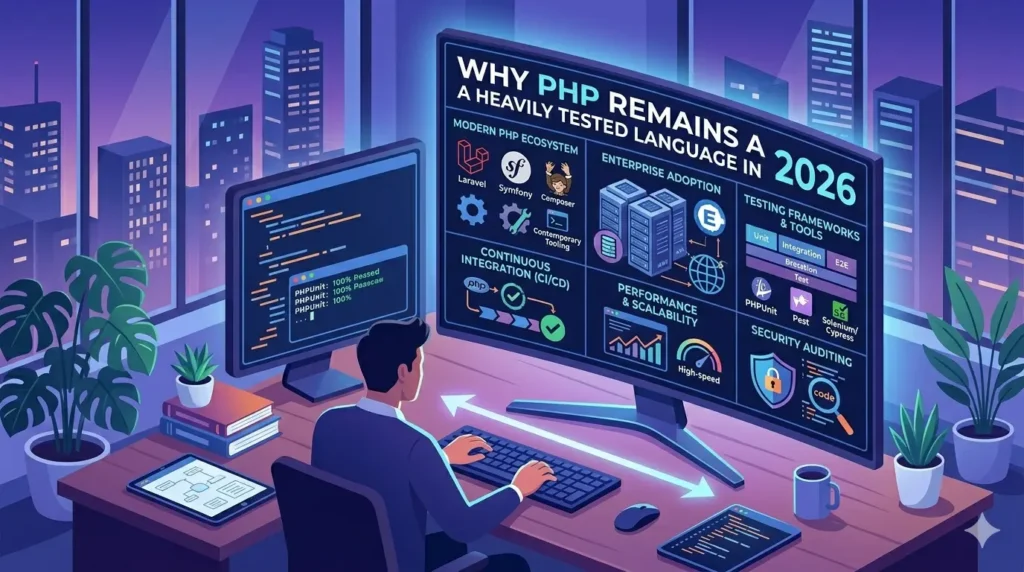
PHP powers the majority of web applications globally despite the rise of newer alternatives. Companies using WordPress, Laravel, Magento, and Drupal continue to hire PHP developers at scale, which means the demand for PHP skills has not slowed down.
Interviewers typically test language fundamentals, OOP principles, security awareness, database interaction, and error handling. With PHP 8.x features now appearing regularly in senior-level interviews, it is no longer enough to know just the basics, you need to understand the modern PHP ecosystem.
Basic PHP Interview Questions (Q1 to Q15)
These questions are typically asked for freshers and candidates with less than 1 year of PHP experience.
Q1. What is PHP and what does it stand for?
PHP stands for Hypertext Preprocessor, it was formerly known as Personal Home Page. It is an open-source, server-side scripting language created by Rasmus Lerdorf in 1994. PHP runs on the server, generates dynamic HTML content, and supports most databases and operating systems. It is one of the most widely used languages for building web applications.
Q2. What are the key features and uses of PHP?
PHP is widely used for dynamic content generation, form handling, session management, email sending, file manipulation, and database interaction. It executes on the server side, meaning the user only receives the output HTML. It is cross-platform, free to use, and integrates easily with MySQL, PostgreSQL, SQLite, and other databases. PHP also powers popular CMS platforms like WordPress, Joomla, and Drupal.
Q3. What is the difference between echo and print in PHP?
Both echo and print are used to output data in PHP, but they have key differences. echo has no return value and is slightly faster because of that. It can also take multiple comma-separated arguments. print, on the other hand, returns 1 and accepts only a single argument. In practice, echo is more commonly used because of its speed and flexibility.
Q4. Is PHP a case-sensitive language?
PHP is partially case-sensitive. Variable names are case-sensitive, meaning $Name and $name are treated as two different variables. However, function names, class names, and keywords like echo, if, and while are not case-sensitive. This is an important distinction that often catches freshers off guard in interviews.
Q5. What are the rules for naming a PHP variable?
A PHP variable must start with the dollar sign ($) followed by a letter or an underscore. It can then contain letters, numbers, and underscores. Variable names cannot contain spaces or special characters. They are also case-sensitive. For example, $user_name is a valid variable, but $1user is not.
Q6. What are the main data types in PHP?
PHP supports eight main data types: Integer (whole numbers), Float (decimal numbers), String (text), Boolean (true or false), Array (collection of values), Object (instance of a class), NULL (a variable with no value), and Resource (a reference to an external resource like a database connection). PHP is a loosely typed language, so variables do not need explicit type declarations.
Q7. What is the difference between == and === in PHP?
The == operator checks for value equality but performs type coercion, it converts values to a common type before comparing. For example, 0 == false returns true. The === operator is strict and checks both value and type without any coercion, so 0 === false returns false. In most cases, === is safer to use because it avoids unexpected results from type juggling.
Q8. What is type juggling in PHP?
Type juggling refers to PHP automatically converting a variable’s data type depending on the context in which it is used. For example, if you multiply a string like “3” by 2, PHP automatically treats it as an integer and returns 6. This automatic conversion is powerful but can lead to subtle bugs if you are not careful about how values are compared or used in expressions.
Q9. What are the different types of errors in PHP?
PHP has four main error types. A Notice is non-critical and appears for minor issues like accessing an undefined variable. A Warning is non-fatal and usually appears for things like including a missing file. A Fatal Error stops script execution entirely, such as calling an undefined function. A Parse or Syntax Error is triggered when PHP cannot understand the code structure, and it also halts execution.
Q10. How do you define a constant in PHP?
Constants are defined using the define() function or the const keyword. Unlike variables, constants do not use a $ prefix and their values cannot be changed once set. Constants are global by default, meaning they can be accessed from anywhere in the script. For example: define(‘MAX_SIZE’, 100); or const MAX_SIZE = 100; inside a class.
Q11. What is the difference between static and dynamic websites?
A static website serves fixed HTML content that does not change unless manually updated by the developer. A dynamic website uses server-side technologies like PHP to generate content at runtime based on user interactions, database queries, or other inputs. PHP is the engine behind most dynamic websites, enabling things like user logins, personalised content, and real-time updates.
Q12. How do you redirect a page in PHP?
Page redirection in PHP is done using the header() function with the Location parameter: header(“Location: https://example.com”);. This must be called before any HTML or output is sent to the browser. It is also a best practice to follow it with exit() to stop further script execution after the redirect is issued.
Q13. What are the different types of loops in PHP?
PHP has four types of loops. The for loop is used when the number of iterations is known in advance. The while loop runs as long as a condition is true. The do-while loop always executes at least once before checking the condition. The foreach loop is specifically designed for iterating over arrays and objects without needing an index counter.
Q14. What is the difference between break and continue in PHP?
break exits the entire loop immediately and stops all further iterations. continue skips the current iteration and moves straight to the next one without exiting the loop. For example, if you use continue inside a foreach when a condition is met, the loop will skip that item and continue processing the remaining items.
Q15. What are the popular PHP frameworks and CMS platforms?
The most popular PHP frameworks include Laravel, CodeIgniter, Symfony, CakePHP, Yii, and Slim. On the CMS side, WordPress is the dominant platform, followed by Joomla, Magento for e-commerce, and Drupal for enterprise sites. Laravel in particular has become the go-to framework for modern PHP development because of its elegant syntax, built-in features, and large community.
PHP Array and String Interview Questions (Q16 to Q24)
Array and string manipulation is one of the most tested practical areas in PHP interviews. Interviewers often ask you to write code using these functions, so knowing the differences matters.
Q16. What is the difference between $arr[] and array_push() in PHP?
Both methods add elements to an array. $arr[] = value; is faster and preferred for adding a single element because it directly modifies the array. array_push() is slightly more readable and allows adding multiple elements in a single call, but it has a small performance overhead since it is a function call. For adding one element at a time, $arr[] is the recommended approach.
Q17. How do you remove duplicate values from an array in PHP?
The array_unique() function removes duplicate values from an array and returns the result. It preserves the original keys of the first occurrence of each value. For example, array_unique([1, 2, 2, 3, 3]) returns [1, 2, 3] while maintaining the original key positions. After applying it, you may want to use array_values() to re-index the array numerically.
Q18. How do you sort an array in ascending and descending order in PHP?
sort() sorts an array in ascending order and re-indexes numeric keys. rsort() sorts in descending order. If you want to preserve key-value associations, use asort() for ascending and arsort() for descending. To sort by key instead of value, ksort() and krsort() are available. For custom sorting logic, usort() lets you define your own comparison function.
Q19. How do you merge two arrays in PHP?
array_merge() combines two or more arrays into one and re-indexes numeric keys. If there are string keys that match, the later array’s values overwrite the earlier ones. The + operator is another way to combine arrays, but it works differently, it keeps the first array’s values in case of duplicate keys and does not re-index. Choose based on whether you need key preservation or not.
Q20. What is the difference between explode() and str_split() in PHP?
explode() splits a string into an array using a specified delimiter. For example, explode(“,”, “a,b,c”) returns [‘a’, ‘b’, ‘c’]. str_split() splits a string into an array of characters or fixed-length chunks. For example, str_split(“hello”, 2) returns [‘he’, ‘ll’, ‘o’]. Use explode() when splitting by a separator and str_split() when splitting by character count.
Q21. What is the difference between str_replace() and str_ireplace() in PHP?
str_replace() performs a case-sensitive search and replace on a string. str_ireplace() does the same thing but in a case-insensitive manner. For example, str_replace(“Hello”, “Hi”, “hello world”) would not find a match because of the capital H, but str_ireplace(“Hello”, “Hi”, “hello world”) would successfully replace it with “Hi world”.
Q22. How do you check if a string contains a specific substring in PHP?
In PHP 8, you can use str_contains($string, $substring) which returns a simple boolean. For older PHP versions, strpos() is used, it returns the position of the first occurrence or false if not found. The important thing is to check with !== false rather than just if(strpos()), because strpos() can return 0 (position of the first character) which is falsy in PHP.
Q23. What is the use of the count() function in PHP?
count() returns the total number of elements in an array. It returns 0 for an empty array or a variable that has not been set. For multidimensional arrays, you can pass COUNT_RECURSIVE as the second argument to count all nested elements. count() is one of the most frequently used array functions in PHP and is commonly tested in interviews.
Q24. What is the difference between array_map(), array_filter(), and array_walk()?
array_map() applies a callback function to each element and returns a new transformed array. array_filter() removes elements that do not pass a given condition and returns the filtered array. array_walk() also applies a function to each element, but it modifies the original array in place and does not return a new array. Use array_map for transformation, array_filter for selection, and array_walk for in-place processing.
PHP OOP Interview Questions (Q25 to Q34)
OOP is tested heavily at mid to senior level and is the foundation for all PHP frameworks. Expect detailed questions on principles, inheritance, interfaces, and advanced concepts like traits and late static binding.
Q25. What are the four main principles of OOP in PHP?
The four pillars of OOP are Encapsulation (hiding internal data and exposing only what is necessary through methods), Inheritance (a child class acquiring properties and methods from a parent class), Polymorphism (the same method behaving differently based on the object), and Abstraction (hiding complex implementation details and showing only what the user needs). These principles apply to PHP classes just as they do in any OOP language.
Q26. What is the difference between a class and an object in PHP?
A class is a blueprint or template that defines the properties and methods an entity will have. An object is a concrete instance of that class with actual values assigned to its properties. For example, Car is a class, and $myCar = new Car(); creates an object of that class. You can create multiple objects from one class, each with its own state.
Q27. What is a constructor and destructor in PHP?
A constructor is a special method called __construct() that is automatically executed when an object is created. It is used to initialise the object’s properties. A destructor is the __destruct() method, which is called when the object is destroyed or goes out of scope. It is used for cleanup operations like closing database connections or freeing resources.
Q28. What are access modifiers in PHP?
PHP has three access modifiers. public makes a property or method accessible from anywhere, inside the class, outside, and in child classes. protected restricts access to the class itself and any child classes that extend it. private is the most restrictive and only allows access from within the class where it is defined. Using the right modifier is key to enforcing encapsulation.
Q29. What is the difference between an abstract class and an interface in PHP?
An abstract class can contain both abstract methods (without implementation) and concrete methods (with implementation). A class can only extend one abstract class. An interface, on the other hand, can only contain method signatures with no implementation, and a class can implement multiple interfaces. Use abstract classes when you want to share some common logic, and interfaces when you want to define a contract without any shared implementation.
Q30. What is inheritance in PHP and how is it implemented?
Inheritance allows a child class to acquire the properties and methods of a parent class using the extends keyword. The child class can use all public and protected members of the parent, and it can also override parent methods to provide its own implementation. PHP only supports single inheritance for classes, meaning a class can extend only one parent, but this limitation can be worked around with traits and interfaces.
Q31. What is polymorphism in PHP? How is it implemented?
Polymorphism means that the same method name can behave differently depending on which object calls it. In PHP, it is implemented through method overriding, a child class defines its own version of a method inherited from the parent. It can also be achieved through interfaces, where different classes implement the same interface method in their own way. This makes code flexible and easy to extend.
Q32. What are traits in PHP and why are they used?
Traits are a mechanism for code reuse in languages that only support single inheritance. A trait is defined with the trait keyword and included inside a class using the use keyword. Traits allow you to share methods across multiple classes without requiring them to be related by inheritance. They are particularly useful in PHP frameworks where common functionality like timestamps or soft deletes is shared across many models.
Q33. What is the difference between $this, self::, and static:: in PHP?
$this refers to the current object instance and is used inside instance methods to access properties and methods of that object. self:: refers to the class in which the method is physically defined, and it does not respect inheritance. static:: enables late static binding and refers to the class that was actually called at runtime, which is important when dealing with inheritance and static methods.
Q34. What are magic methods in PHP? Give examples.
Magic methods are special methods that PHP calls automatically in specific situations. They always start with a double underscore. Common examples include: __construct() called on object creation, __destruct() on object destruction, __get() and __set() for accessing inaccessible properties, __toString() when an object is used as a string, __call() for calling inaccessible methods, and __clone() when an object is cloned. They give PHP classes a lot of power and flexibility.
PHP Sessions, Cookies, and Forms Interview Questions (Q35 to Q39)
Q35. What is the difference between a session and a cookie in PHP?
A session stores data on the server and is identified by a session ID sent to the client as a cookie. Sessions are more secure because the actual data never leaves the server. A cookie stores data directly on the client’s browser and can persist for a set duration. Cookies are accessible by the client and therefore less secure. Sessions expire when the browser closes by default, while cookies can be set to last for days or years.
Q36. What is the difference between session_unset() and session_destroy()?
session_unset() clears all variables stored in the current session, but the session itself still exists and the session ID remains valid. session_destroy() goes further and completely destroys the session on the server, invalidating the session ID and removing the session file. To fully log out a user, you should use both: first session_unset() to clear the data, then session_destroy() to end the session entirely.
Q37. How does PHP handle form data?
PHP handles form data through three superglobals. $_GET contains data submitted via the URL query string and is visible in the browser address bar. $_POST contains data sent via the HTTP POST method in the request body, making it invisible in the URL and slightly more secure for sensitive data. $_REQUEST is a combined superglobal that contains data from both $_GET and $_POST along with $_COOKIE.
Q38. What are PHP superglobals?
Superglobals are built-in variables that are always accessible from any scope in a PHP script, inside functions, classes, or files, without needing to use the global keyword. PHP has nine superglobals: $_GET, $_POST, $_REQUEST, $_SESSION, $_COOKIE, $_SERVER, $_FILES, $_ENV, and $GLOBALS. Each one serves a specific purpose related to data input, server info, or file uploads.
Q39. How do you handle file uploads in PHP?
File uploads in PHP are handled through the $_FILES superglobal, which contains information about the uploaded file including its name, type, size, and temporary path. After validating the file type and size, you use move_uploaded_file() to move the file from its temporary location to the desired directory. Always check the error code in $_FILES[‘file’][‘error’] and validate the MIME type server-side to prevent malicious uploads.
PHP Security Interview Questions (Q40 to Q44)
Security questions appear in every serious PHP interview and are critical for any developer working in production environments.
Q40. How do you sanitise user input in PHP?
Sanitising user input means cleaning it before processing or storing it. htmlspecialchars() converts special HTML characters to their safe entities, preventing XSS. strip_tags() removes all HTML and PHP tags from input. filter_var() with various FILTER_SANITIZE flags can clean emails, URLs, integers, and more. The golden rule is to never trust raw user input, always sanitise before output and validate before logic.
Q41. What is SQL injection and how do you prevent it in PHP?
SQL injection is an attack where a malicious user embeds SQL code into an input field to manipulate or destroy your database. For example, entering ‘ OR ‘1’=’1 into a login form can bypass authentication. The safest prevention is using PDO with prepared statements and parameterised queries. This separates the SQL structure from the user data, making injection impossible. Never directly concatenate user input into an SQL query string.
Q42. What is Cross-Site Scripting (XSS) and how do you prevent it in PHP?
XSS is an attack where a malicious user injects JavaScript or HTML into your page, which then executes in the browsers of other users. The primary prevention in PHP is to use htmlspecialchars() on any data being echoed to the page. Additionally, implementing a Content Security Policy (CSP) header restricts what scripts can run. Never echo raw user input directly into the page, always encode it first.
Q43. What is the most secure way to hash passwords in PHP?
PHP provides password_hash() for secure password hashing. It supports algorithms like PASSWORD_BCRYPT and PASSWORD_ARGON2ID, both of which automatically handle salting and are designed to be slow (making brute force attacks harder). To verify a password, use password_verify(). Never use MD5 or SHA1 for passwords, they are fast hashing algorithms designed for checksums, not security, and can be reversed with rainbow tables.
Q44. What is CSRF and how do you prevent it in PHP?
Cross-Site Request Forgery (CSRF) is an attack that tricks an authenticated user into unknowingly submitting a malicious request, for example, transferring money or changing account settings. Prevention involves generating a unique CSRF token for each form, storing it in the session, and validating it on form submission. Using the SameSite attribute on cookies also helps prevent CSRF by restricting cross-origin cookie sending.
PHP Database and PDO Interview Questions (Q45 to Q48)
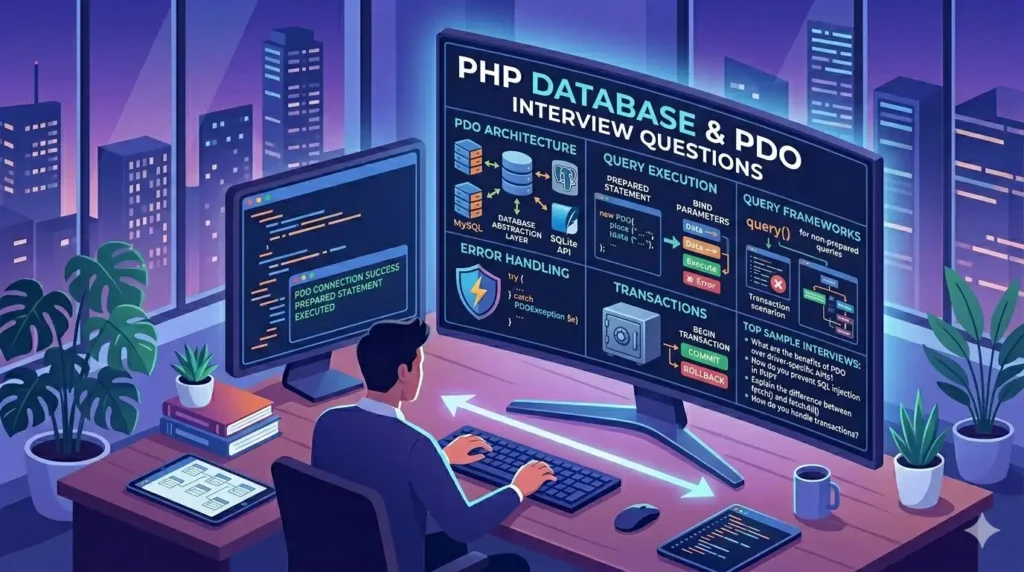
Q45. What is PDO in PHP and why is it preferred over mysqli?
PDO stands for PHP Data Objects and is a database abstraction layer that supports 12 different database drivers including MySQL, PostgreSQL, SQLite, and more. This makes your code portable across different databases. mysqli, on the other hand, only works with MySQL. PDO also provides a cleaner, object-oriented interface, exception-based error handling, and native support for prepared statements, making it the preferred choice for modern PHP applications.
Q46. What are prepared statements in PHP and why are they important?
Prepared statements are pre-compiled SQL templates that use placeholders instead of directly embedding user input. The SQL structure is sent to the database first, and then the actual parameter values are bound and sent separately. This two-step process makes SQL injection impossible because user input is always treated as data, not code. Prepared statements also improve performance for repeated queries since the query only needs to be parsed once.
Q47. What is the difference between fetch() and fetchAll() in PDO?
fetch() retrieves a single row at a time from the result set and is more memory-efficient for large datasets. fetchAll() retrieves all rows at once and loads them into a PHP array. For small results, fetchAll() is convenient. For large results with thousands of rows, fetch() inside a loop is better because it avoids loading everything into memory at once.
Q48. What are the different PDO fetch modes?
PDO offers several fetch modes that determine how rows are returned. PDO::FETCH_ASSOC returns an associative array using column names as keys. PDO::FETCH_OBJ returns an anonymous object with column names as properties. PDO::FETCH_NUM returns a numerically indexed array. PDO::FETCH_BOTH returns both associative and numeric indexes. You set the fetch mode using the setFetchMode() method or as a parameter in fetch().
Advanced PHP Interview Questions (Q49 to Q50)
Q49. What are the key new features introduced in PHP 8?
PHP 8 introduced several major features. Named arguments allow passing values by parameter name instead of position. Union types let a parameter accept multiple types. The match expression is a cleaner alternative to switch. The nullsafe operator (?->) allows chaining methods without null checks. Constructor property promotion reduces boilerplate. The JIT (Just-In-Time) compiler improves performance for CPU-intensive tasks. New string functions like str_contains(), str_starts_with(), and str_ends_with() also simplify common operations.
Q50. What is PEAR in PHP?
PEAR stands for PHP Extension and Application Repository. It is a framework and distribution system for reusable PHP components and libraries. PEAR provides a command-line package manager for installing and managing PHP packages and helped standardise code reuse before Composer became the dominant dependency manager. While PEAR is less commonly used in modern projects, it still appears in legacy codebases and can come up in interviews.
PHP Interview Questions by Experience Level
Freshers and Entry-Level
Focus areas: PHP syntax, variable rules, data types, echo vs print, loops, arrays, basic string functions, sessions vs cookies, form handling with $_GET and $_POST, and the four main error types. Be prepared to write basic code snippets and explain fundamental concepts clearly.
Mid-Level Developers (2 to 4 years)
Focus areas: OOP principles, abstract classes vs interfaces, traits, magic methods, PDO and prepared statements, security (XSS, SQL injection, CSRF), array manipulation functions, and sessions and cookies in depth. Expect coding challenges and questions about your real-world project experience.
Senior Developers (5 or more years)
Focus areas: late static binding, PHP 8 features, design patterns in PHP, performance optimisation, opcode caching with OPcache, PHP-FPM, memory management, testing with PHPUnit, and advanced security practices. Senior interviews often focus heavily on architectural decisions and trade-offs.
How to Prepare for PHP Interview Questions
Must-Study Topics in Order
1. PHP syntax, variables, data types, and operators
2. Control structures: loops and conditionals
3. Arrays and string functions
4. Functions: built-in, user-defined, variable functions, anonymous functions
5. OOP: classes, objects, constructors, inheritance, interfaces, traits
6. Error handling: try/catch/finally, custom error handlers
7. Sessions and cookies
8. Security: input sanitisation, password hashing, SQL injection prevention
9. PDO and prepared statements
10. PHP 8 new features
Best Practice Resources
PHP Official Documentation at php.net is the most authoritative source. GeeksforGeeks and NetmaxTech both have solid PHP Q&A guides. W3Schools is good for quick syntax reference. For PHP applied in a real framework, Laracasts is highly recommended for Laravel.
Interview Day Tips
Know the difference between == and === cold and always have a concrete example ready. Be prepared to write a simple PDO query with a prepared statement from memory. Know at least five array functions with their exact signatures. Whenever you discuss form handling or database queries, proactively mention security considerations, it shows maturity and impresses interviewers.
Frequently Asked Questions (FAQ)
What PHP topics are most commonly asked in interviews?
The most tested topics are PHP basics (data types, variables, operators), OOP principles, array and string functions, sessions and cookies, security (SQL injection, XSS, CSRF), and PDO with prepared statements. For senior roles, PHP 8 features and design patterns are also commonly covered.
Is PHP 8 knowledge required in 2026 interviews?
Yes, for mid and senior roles, knowledge of PHP 8 features like named arguments, union types, the match expression, the nullsafe operator, and the JIT compiler is increasingly expected. Even for entry-level roles, having some awareness of PHP 8 improvements shows initiative.
Do I need to know a PHP framework for a PHP interview?
It depends on the role. Many companies ask specifically about Laravel or WordPress. While you may be tested on core PHP without frameworks, knowing at least one popular framework like Laravel significantly increases your chances. Frameworks also reinforce OOP concepts, which are heavily tested.
What is the difference between PHP and Python for web development?
PHP was built specifically for web development and integrates natively with HTML. Python is a general-purpose language that uses frameworks like Django and Flask for web development. PHP has a larger share of existing websites (especially via WordPress), while Python is growing rapidly in web, data science, and AI. For backend web roles with existing PHP stacks, PHP knowledge is essential.
How long does it take to prepare for a PHP developer interview?
For freshers, 2 to 4 weeks of focused study covering this guide should be sufficient for an entry-level interview. For mid-level roles, 1 to 2 weeks of revision focusing on OOP and security is usually enough if you already have hands-on experience. Senior roles may require deeper preparation on architecture, design patterns, and performance.
Conclusion
This guide covered all 50 PHP interview questions across every key category, from PHP basics and data types through to OOP, security, database handling, and advanced PHP 8 features. Whether you are a fresher preparing for your first interview or an experienced developer brushing up for a senior role, mastering these questions will give you the foundation to answer with confidence.
For more practice, explore our Top 50 Technical Interview Questions guide and our Top 50 Laravel Interview Questions guide to continue building your backend expertise.